
SwiftPropel managed Google Ads for an online language-learning platform offering course paths across multiple languages and learning formats.
The strategic challenge was not simply to attract people interested in language learning.
It was to turn broad learning intent into relevant course exploration.
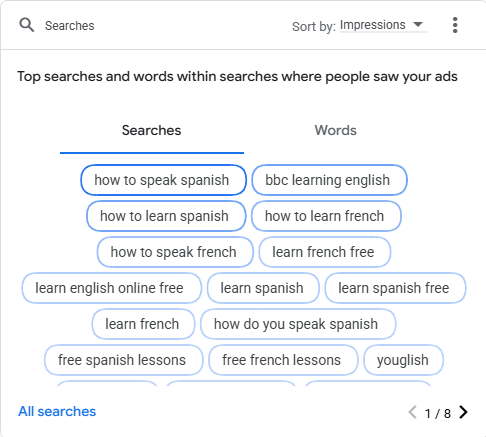
Search behavior included queries such as:
- How to speak Spanish
- How to learn Spanish
- How to speak French
- How to learn French
- Learn English online
- Learn Spanish free
- Free French lessons
These searches represent different stages of learner intent.

Some people are actively comparing classes. Some are looking for free resources. Some are exploring a language for the first time. Others are ready to begin a structured course.
SwiftPropel built the Google Ads system around that reality.
The Challenge
A broad “learn languages online” campaign would have created a relevance problem.
Someone interested in English does not need the same message, CTA, or course path as someone looking for Spanish, French, Arabic, or a discounted group-learning option.
The account needed to do three things:
- Capture broad language-learning demand
- Route learners toward the most relevant language path
- Use display and remarketing to bring interested visitors back after their first interaction
The reporting challenge was equally important.
Google Ads tracked course-interest actions across the website, but the available conversion taxonomy included CTA clicks such as Get Started, Learn English, Learn Spanish, Learn French, Explore, and Begin Your Journey.
For that reason, this case study reports tracked course-discovery actions—not qualified leads, paid enrollments, or revenue.
The Strategic Premise
The account was built around one principle:
Broad language-learning searches should not lead to one generic page or one generic CTA.
The right acquisition path is:
Language-learning search → language-specific course route → relevant offer → course exploration → next-step action
That meant campaigns had to be organized around learner intent rather than one undifferentiated audience.
Campaign Architecture
The Google Ads account included:
- English-focused Search campaigns
- Spanish-focused Search campaigns
- French-focused Search campaigns
- Broader language-learning Search campaigns
- Catch-all language-intent campaigns
- Interest-based Display campaigns
- Competitor-focused Display targeting
- Website-visitor remarketing
- Offer-led CTA campaigns
- Course-entry and language-specific website paths
The Display structure also included separate audience layers for interest targeting, competitor audiences, and retargeting.
| Campaign Layer | Role |
|---|---|
| Language-specific Search | Capture active demand for English, Spanish, French, and related learning paths |
| Broader Search | Capture wider language-learning and course-discovery intent |
| Interest-based Display | Create discovery among potential language learners |
| Competitor targeting | Reach people comparing alternative learning options |
| Remarketing | Re-engage visitors who had already shown course interest |
| Offer-led CTAs | Test discounted, free-class, and course-start messaging |
Strategy
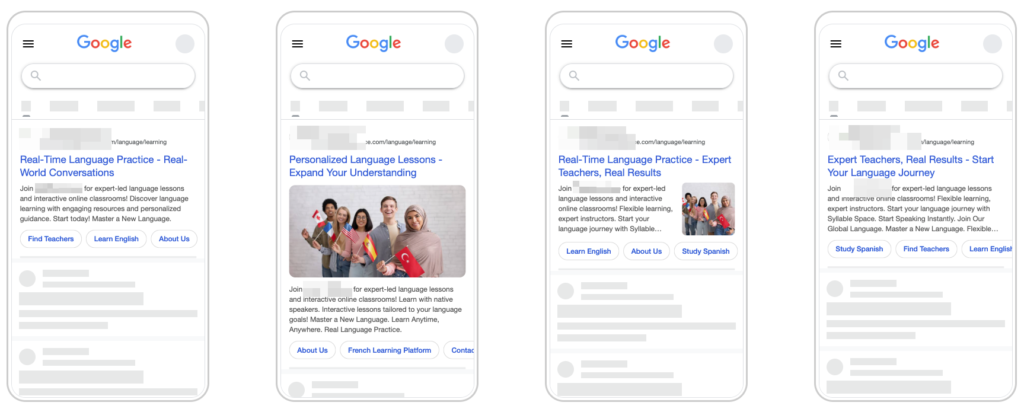
1. Route learners by language intent
Search and landing experiences were structured around specific learning interests rather than one universal course message.
Campaign activity supported distinct learner paths, including:
- Learn English
- Learn Spanish
- Learn French
- Learn Arabic
- General course exploration
- Offer-led learning paths
This created better alignment between:
- Search query
- Ad message
- Course CTA
- Website route
- Likely learner intent
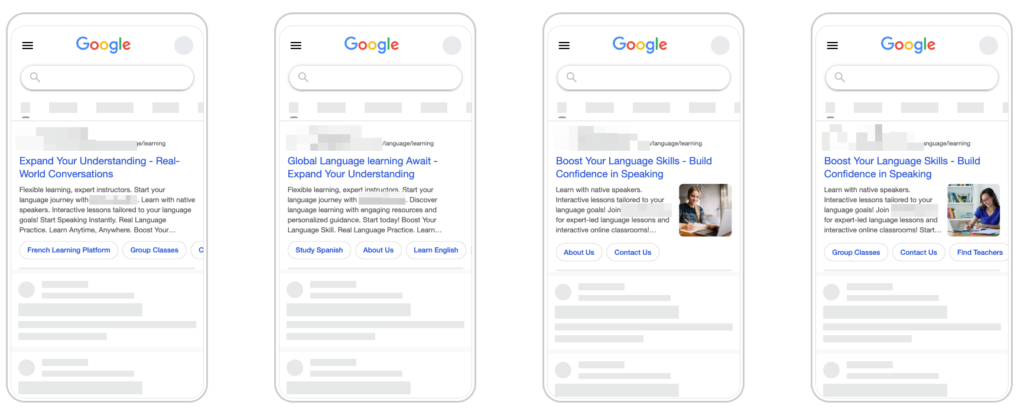
2. Use Search to capture active learning demand
Search campaigns focused on people already looking for language-learning solutions.
This included instructional searches, language-specific queries, free-learning searches, and broader course-intent terms.
The strategic job of Search was not only to generate clicks.
It was to identify which language interests were producing meaningful course-entry activity and allocate more budget toward those demand segments.
3. Use Display for scalable discovery and re-engagement
Display was used as the scale layer.
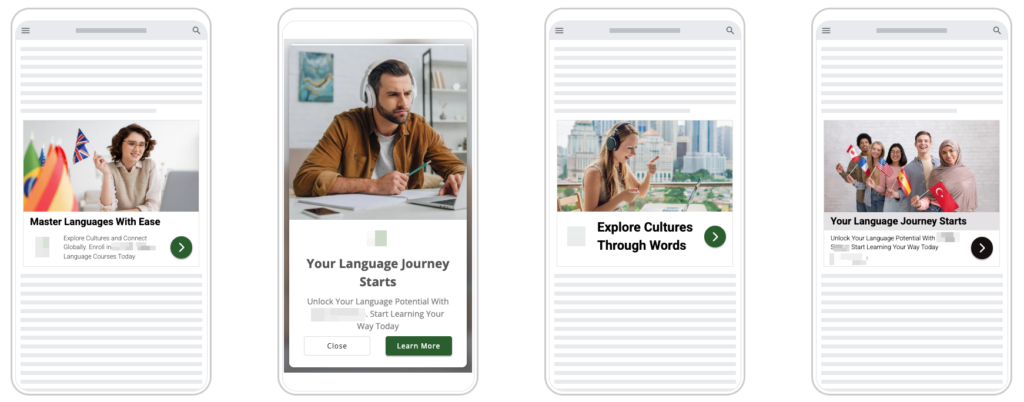
It expanded reach among people with relevant interests, supported competitor comparison behavior, and brought previous visitors back into the course-discovery journey.
Display was not presented as a student-enrollment channel.
Its role was to generate awareness, lower-cost course exploration, and remarketing opportunities before a learner was ready to take a deeper action.
4. Test multiple conversion hooks
The campaign did not rely on one CTA.
It tested different entry points based on learner readiness, including:
- Get Started
- Begin Your Journey
- Learn English
- Learn Spanish
- Learn French
- Learn Arabic
- Explore
- Get 25% Off
- Get a Free Class
- Book Now
This allowed the account to capture interest from learners at different stages of commitment.
5. Separate course interest from commercial outcomes
The conversion setup measured user actions across the course-discovery journey.
This included language-selection clicks, course-entry clicks, offer interactions, submit-button actions, booking actions, contact actions, and phone-click actions.
These are useful optimization signals.
They are not automatically proof of:
- Qualified leads
- Trial attendance
- Paid course enrollments
- Purchases
- Revenue
- Return on ad spend
Results
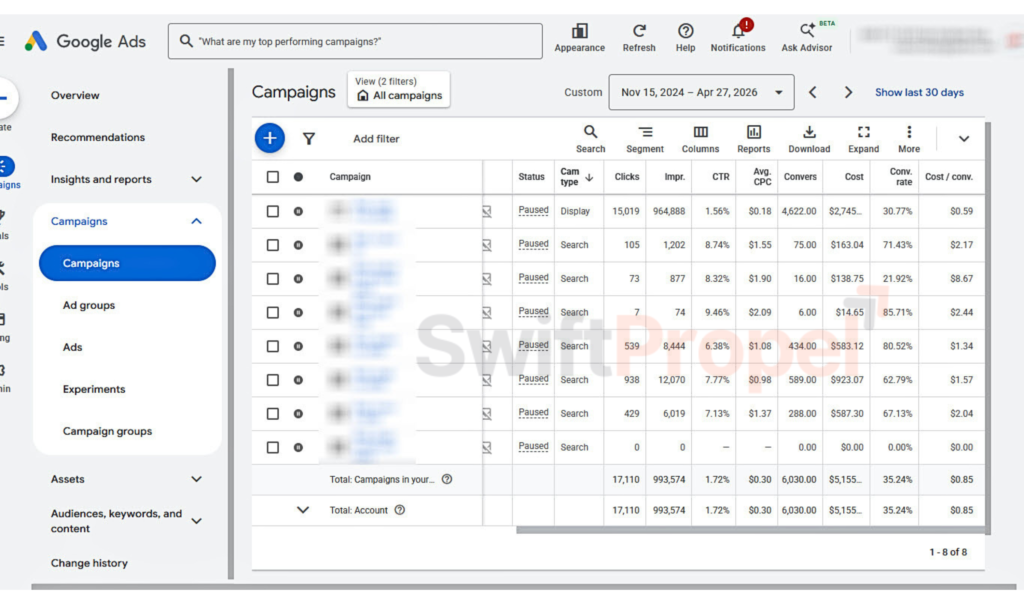
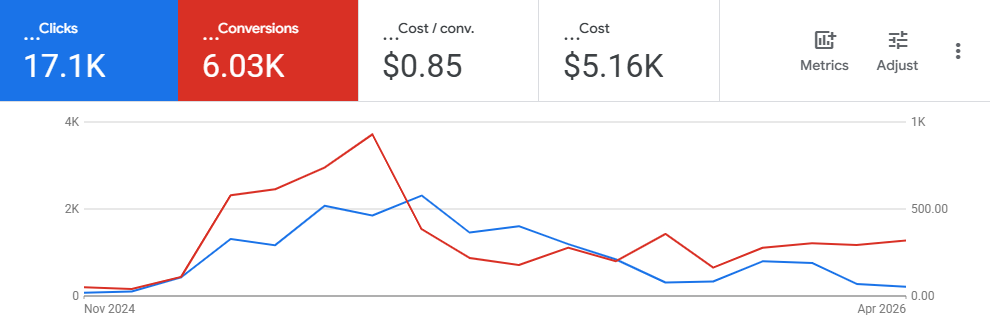
Reporting period: November 15, 2024 to April 27, 2026
| Metric | Result |
|---|---|
| Google Ads spend | US$5.16K |
| Impressions | 993.6K |
| Clicks | 17.1K |
| Click-through rate | 1.72% |
| Average CPC | US$0.30 |
| Tracked Google Ads course-interest actions | 6,030 |
| Cost per tracked action | US$0.85 |
Channel-Level Performance
| Campaign Type | Spend | Clicks | Tracked Actions | Cost per Action |
|---|---|---|---|---|
| Display | US$2.75K | 15,019 | 4,622 | US$0.59 |
| Search | US$2.41K | 2,091 | 1,408 | US$1.71 |
Display created scalable, low-cost course-discovery activity.
Search captured more direct language-learning intent, where users were actively looking for a course, language resource, or learning path.
Language-Specific Search Performance
The highest-volume language-specific Search campaign groups were:
| Course Path | Clicks | Tracked Actions | Cost per Action |
|---|---|---|---|
| English | 938 | 589 | US$1.57 |
| Spanish | 539 | 434 | US$1.34 |
| French | 429 | 288 | US$2.04 |
These language-specific Search groups generated 1,311 tracked course-interest actions.
That supported the underlying strategy: course discovery performs better when search intent is matched to a clear language path rather than one generic learning offer.
Course-Discovery CTA Activity
Google Ads tracked strong activity around course-entry and language-selection actions.
| CTA Action | Tracked Actions |
|---|---|
| Get Started | 2,356 |
| Learn English | 1,102 |
| Learn Spanish | 517 |
| Learn French | 515 |
| Explore | 310 |
| Begin Your Journey | 294 |
| Learn Arabic | 88 |
| Get 25% Off | 95 |
The four primary course-discovery actions—Get Started, Learn English, Learn Spanish, and Learn French—generated 4,490 tracked actions.
This demonstrates that users were not only viewing ads. They were actively selecting course paths and entering the learning journey.
What the Results Mean
With US$5.16K in Google Ads spend, SwiftPropel generated:
- Nearly 1 million impressions
- More than 17,000 clicks
- A US$0.30 average CPC
- 6,030 tracked course-interest actions
- 2,356 Get Started actions
- 2,134 language-specific English, Spanish, and French CTA actions
- 1,311 tracked actions from English, Spanish, and French Search campaign groups
- A low-cost Display discovery layer combined with more intent-led Search campaigns
The account was not optimized around one generic language-learning audience.
It was built to route people from broad learning intent into more relevant language and course paths.
Measurement Note
The 6,030 figure represents Google Ads-recorded conversion actions.
It is not presented as 6,030 leads, students, enrollments, purchases, or paid course registrations.
The conversion taxonomy included actions such as:
- Get Started clicks
- Learn-language CTA clicks
- Explore clicks
- Discount CTA clicks
- Submit-button clicks
- Book Now clicks
- Contact clicks
- Phone-number clicks
- Profile and course-page interactions
Google Analytics was not used to validate Google Ads traffic or downstream outcomes because the available GA4 channel attribution does not reconcile with Google Ads click volume.
For that reason, this case study does not claim:
- Qualified lead volume
- Trial attendance
- Course registrations
- Paid enrollments
- Revenue
- Return on ad spend
Key Lesson
For a multi-language education business, campaign structure should reflect what a learner wants to learn.
A person searching for English, Spanish, French, or Arabic is not one generic “online education” audience.
They have different motivations, different search behavior, and different reasons to act.
The stronger acquisition model is:
- Capture broad language-learning demand
- Segment by specific language interest
- Match each language with relevant CTA paths
- Use Display for scalable discovery
- Use Search for active learning intent
- Use remarketing to bring interested learners back
- Measure course-discovery actions separately from true commercial outcomes
The advantage was not simply lower-cost clicks.
It was creating a clearer path from broad language curiosity to relevant course exploration.
Engagement Type
Google Ads campaign management, Search campaigns, language-specific course targeting, English, Spanish, French, and Arabic campaign support, Display campaigns, competitor targeting, interest-based targeting, remarketing, CTA testing, offer testing, keyword expansion, search-term management, negative-keyword refinement, campaign restructuring, and performance reporting.
Need Google Ads that routes broad education searches into relevant course paths?
SwiftPropel builds acquisition systems that connect search intent, course relevance, audience discovery, remarketing, and measurable user actions into one structured growth engine.

Vijay Sood is a seasoned digital marketer with a passion for driving online growth and innovation. With a robust background in developing and executing comprehensive digital strategies, Vijay excels in leveraging SEO, content marketing, and social media to boost brand visibility and engagement. His expertise lies in transforming data-driven insights into actionable marketing campaigns, helping businesses achieve their digital objectives.