
See how SwiftPropel helped a restricted telehealth weight-loss provider generate 91 tracked enquiry actions through a compliance-first, Search-led Google Ads campaign.
SwiftPropel was engaged to build and manage Google Ads for a telemedicine weight-loss provider based in South Carolina.
The business objective was to generate prospective patient enquiries for telemedical weight-loss services.
This was not a standard lead-generation account.
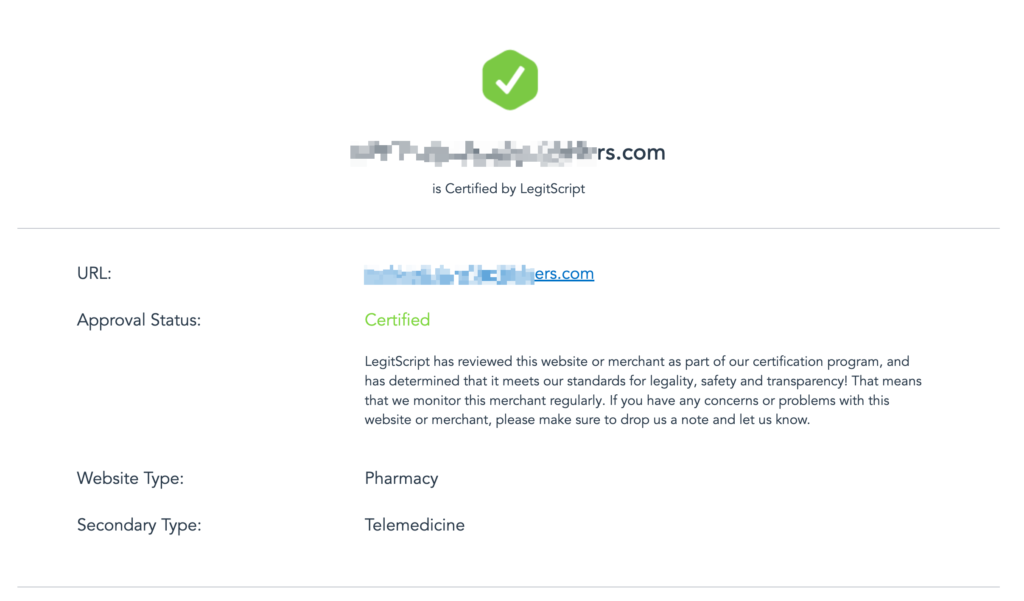
The client operated in a sensitive healthcare and prescription-adjacent category. Meta Ads was not a viable acquisition channel because of platform restrictions, so SwiftPropel first helped the client move through the required certification-readiness process before building the Google Ads account.
Once the account was active, the strategy focused on search-led demand capture rather than broad awareness.
The campaign needed to reach people actively searching for weight-loss support, online medical guidance, consultation options, and telehealth-based weight-management solutions.
The Challenge
Telehealth weight-loss advertising creates three immediate problems:
- Platform access is not guaranteed.
- Search demand is expensive and highly competitive.
- Not every conversion action is equal.

The account had to compete against national telehealth brands, prescription-related searches, weight-loss apps, and commercial weight-loss providers.
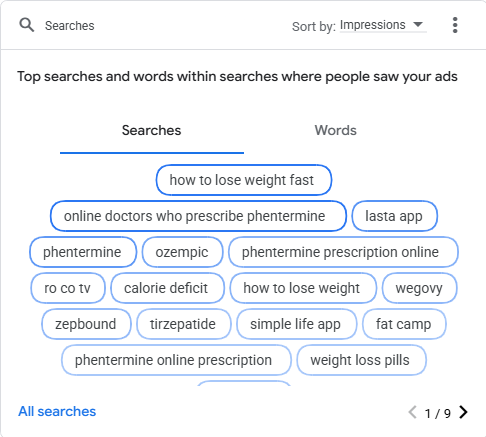
Search behaviour included terms around:
- How to lose weight
- Medical weight-loss support
- Online doctors
- Prescription-related weight-loss queries
- Telehealth weight-loss options
- Branded medication-related search demand
- Competitor and app-based alternatives
This created a difficult acquisition environment.
The goal was not cheap traffic.
The goal was to capture people showing enough intent to request information, submit a lead form, or click toward a free consultation.
The Strategic Premise
The account was built around one principle:
In restricted healthcare categories, the first win is not scale. The first win is getting qualified search demand into a compliant enquiry path.
For this client, SwiftPropel’s job was to create a controlled Google Ads system that could:
- Operate within platform limitations
- Focus on Search rather than low-quality awareness
- Capture high-intent telehealth and weight-loss queries
- Route users toward free consultation and contact paths
- Track enquiry actions separately from softer website activity
- Avoid overstating conversions as actual patients
Campaign Architecture
SwiftPropel built the account from scratch and managed it across the full engagement period.
The structure included:
- Search campaigns for medical weight-loss demand
- Search campaigns for virtual weight-loss demand
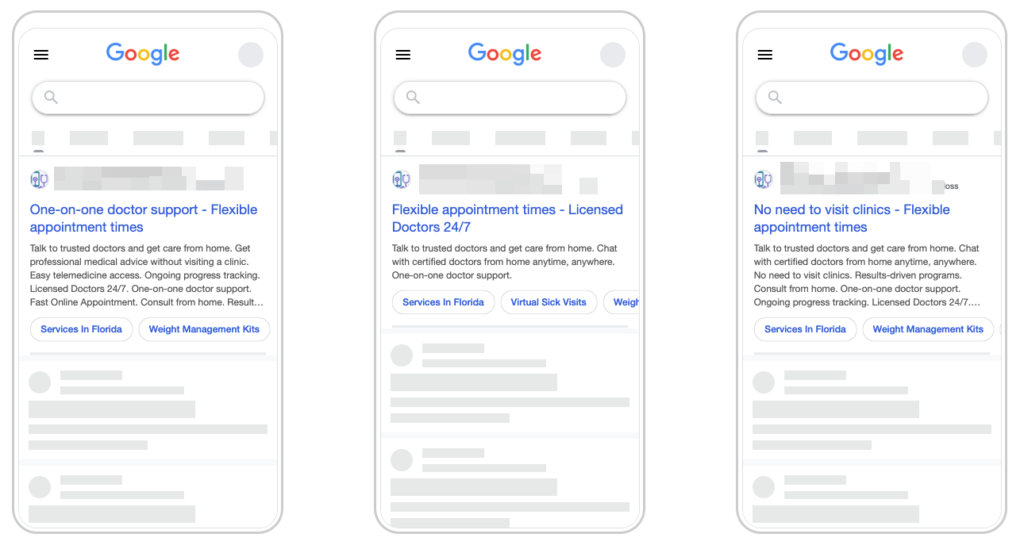
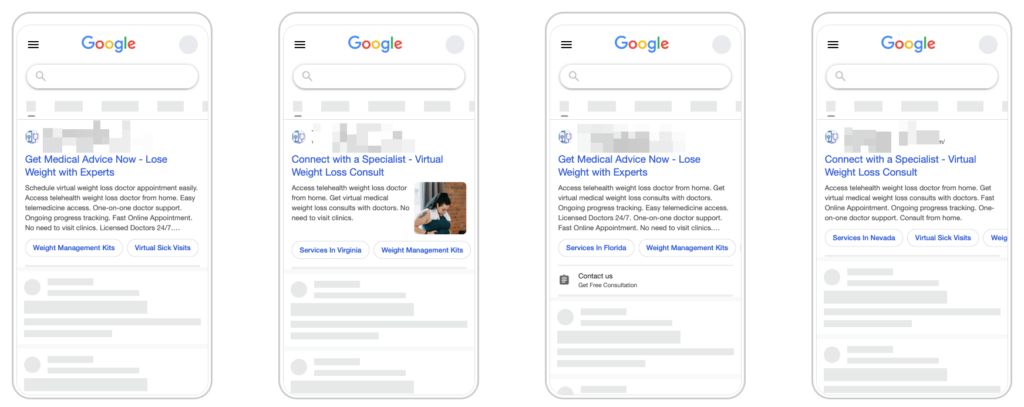
- Consultation-focused ad messaging
- Contact-path tracking
- Lead-form tracking
- Free-consultation CTA tracking
- Search-query refinement
- Negative-keyword work
- Policy-sensitive ad review and adjustments
Display and remarketing layers were created, but the revised export shows that active delivery and measurable performance came from Search. Display campaigns recorded no meaningful delivery because of policy limitations.
That matters.
This case study should not pretend Display or remarketing drove the result. The credible story is a Search-led campaign in a restricted category.
Strategy
1. Solve the platform-access problem before scaling
The client could not rely on Meta Ads.
SwiftPropel helped the client move through the certification-readiness process required before running compliant acquisition activity for this type of offer.
Only after that foundation was in place did the Google Ads buildout become commercially useful.
The strategic sequencing was:
Platform restriction → certification pathway → Google Ads account buildout → Search demand capture
2. Focus on intent, not volume
Weight-loss search traffic can be broad, expensive, and misleading.
A user searching “how to lose weight fast” is not the same as a user searching for an online medical weight-loss provider or consultation option.
SwiftPropel focused campaign structure around search intent that had a clearer path to enquiry.
This included separating general weight-loss demand from more service-specific and virtual-care search behaviour.
3. Build the campaign around consultation intent
The core conversion actions were structured around next-step patient enquiry behaviour.
The main tracked actions were:
- Submit lead form
- Click Get a Free Consultation
- Click Contact Us
This made the funnel cleaner.
Instead of optimizing only for traffic, the account measured whether users were moving toward actual enquiry paths.
4. Treat search-query control as a risk-management function
In a sensitive medical category, irrelevant search traffic does not only waste money. It can also create policy, compliance, and lead-quality problems.
SwiftPropel used search-term review and negative-keyword refinement to reduce low-fit traffic and improve relevance over time.
This was especially important because the account was exposed to a mix of commercial, educational, prescription-related, competitor, and app-related queries.
5. Separate enquiry actions from actual patient outcomes
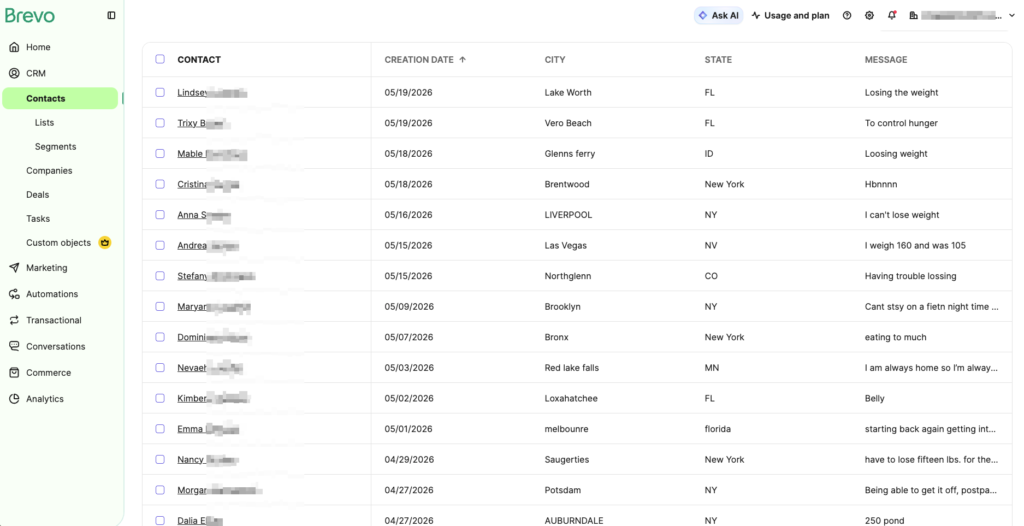
The client collected leads through Brevo forms, but SwiftPropel did not have final patient intake, appointment, treatment, or revenue data.
For that reason, the case study reports Google Ads-tracked enquiry actions.
It does not claim patient starts, treatment plans, booked appointments, prescription outcomes, revenue, or ROI.
Results
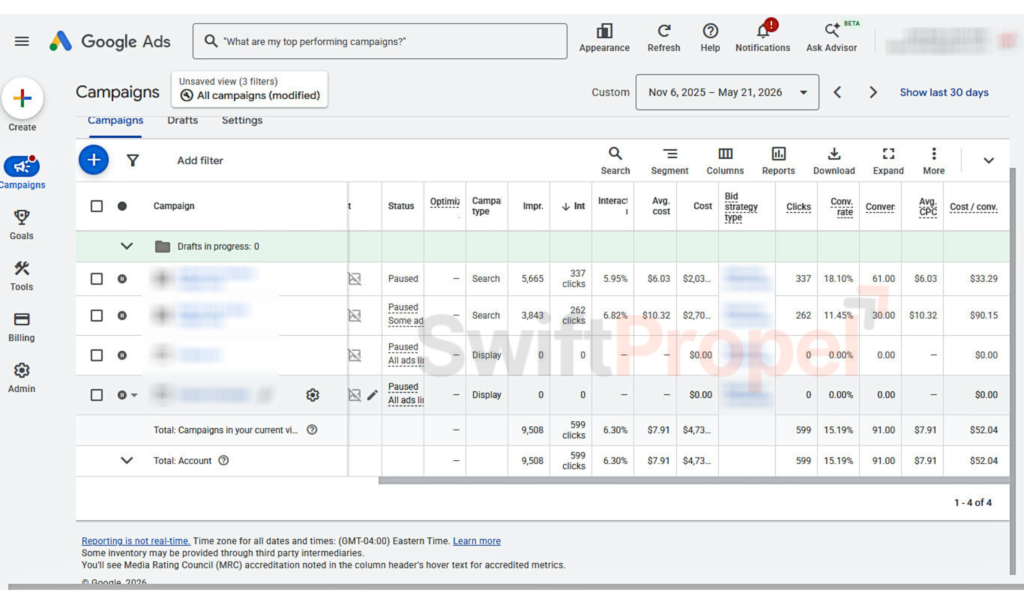
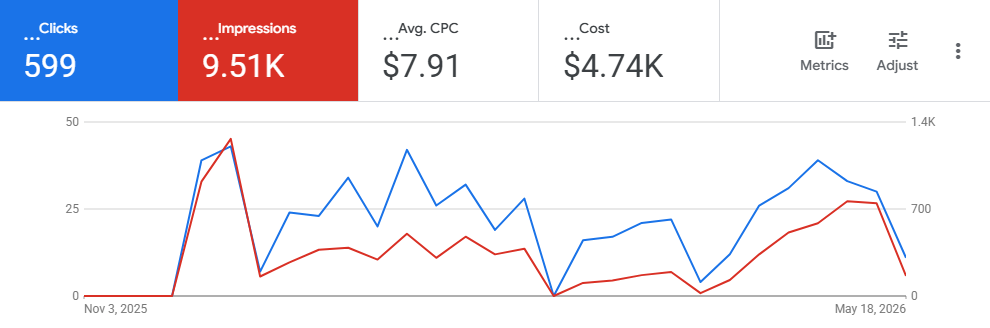
Campaign period: November 6, 2025 to May 21, 2026
| Metric | Result |
|---|---|
| Google Ads spend | US$4,735.39 |
| Impressions | 9,508 |
| Clicks | 599 |
| Click-through rate | 6.30% |
| Average CPC | US$7.91 |
| Tracked Google Ads conversion actions | 91 |
| Conversion rate | 15.19% |
| Cost per tracked conversion action | US$52.04 |
Conversion Action Breakdown
| Tracked Action | Result |
|---|---|
| Click_Get a Free Consultation | 42 |
| Submit lead form | 42 |
| Click_Contact Us | 7 |
| Total tracked conversion actions | 91 |
The strongest lead-path signals were evenly split between direct form submission and free-consultation intent.
This matters because consultation clicks and submitted forms represent different levels of commitment. They should be reported separately, not blended into a single “patient” number.
Ad Group Performance
| Ad Group | Impressions | Clicks | Conversions | Cost per Conversion |
|---|---|---|---|---|
| Medical weight-loss search group | 5,665 | 337 | 61 | US$33.29 |
| Medical weight-loss group | 3,001 | 157 | 20 | US$68.41 |
| Virtual weight-loss group | 842 | 105 | 10 | US$133.63 |
The strongest ad group generated 61 of the 91 tracked conversion actions at US$33.29 per tracked action.
That became the clearest performance signal in the account.
The virtual weight-loss segment generated enquiry activity, but at a materially higher cost per conversion. That indicates the account needed budget discipline and ongoing keyword refinement rather than equal spend across every search theme.
Website Engagement Context
GA4 showed that the website generated 15,051 views, 7,318 active users, and 39,512 total events during the same reporting window. The highest-volume pages were the medical weight-loss program page, homepage, contact page, and about page.
| Page Path | Views | Strategic Role |
|---|---|---|
/medical-weight-loss-program/ | 4,884 | Main service-intent page |
/ | 4,509 | General provider discovery |
/contact-us/ | 1,581 | Enquiry path |
/about-us/ | 1,554 | Trust and provider evaluation |
/weight-loss-journey-to-health-and-wellness/ | 341 | Educational support content |
/online-appointments/ | 214 | Appointment-intent path |
/semaglutide-weight-loss/ | 185 | Treatment-related information path |
/thank-you/ | 110 | Post-submit confirmation path |
This supports the strategic view that users were not only clicking ads. They were moving into medical-weight-loss, contact, provider-trust, appointment, and treatment-information pages.
Geographic Context
The United States was the largest and strongest website traffic segment, accounting for 4,269 active users, 2,779 engaged sessions, and a 62.32% engagement rate during the reporting window.
This is important because the campaign was built for a U.S.-based telehealth provider. Non-U.S. traffic existed, but the strongest engagement came from the United States.
Traffic Source Context
GA4 showed that Paid Search generated 585 sessions with a 50.6% engagement rate and 27 seconds average engagement time per session. The Paid Search session volume aligns closely with the Google Ads click volume, which makes the traffic story more internally consistent than some previous projects.
| Channel | Sessions | Engagement Rate |
|---|---|---|
| Direct | 3,865 | 18.16% |
| Organic Search | 2,087 | 88.84% |
| Organic Social | 870 | 31.26% |
| Paid Search | 585 | 50.60% |
| Referral | 227 | 22.91% |
Paid Search was not the largest website channel, but it was the paid acquisition engine tied directly to tracked enquiry actions.
What the Results Mean
With US$4.74K in Google Ads spend, SwiftPropel generated:
- 9,508 impressions
- 599 clicks
- 6.30% CTR
- 91 tracked enquiry actions
- 42 submitted lead-form actions
- 42 free-consultation clicks
- 7 Contact Us clicks
- US$52.04 cost per tracked conversion action
- Strongest ad group performance at US$33.29 per tracked conversion action
For a restricted telehealth weight-loss provider, this is a more credible proof point than broad awareness volume.
The campaign created a controlled Google Search acquisition path for people actively looking for medical weight-loss and virtual weight-loss support.
Measurement Note
The 91 tracked conversion actions are not reported as 91 patients.
They are Google Ads-tracked enquiry actions.
The campaign did not have confirmed access to downstream patient-intake data, appointment attendance, treatment starts, prescription outcomes, revenue, or lifetime value.
Therefore, this case study does not claim:
- New patients acquired
- Qualified patient volume
- Booked medical appointments
- Completed consultations
- Treatment plans started
- Prescriptions issued
- Revenue
- Return on ad spend
- Health outcomes
GA4 recorded only 1 form_submit event during the same reporting window, while Google Ads recorded 42 Submit Lead Form conversions. This indicates that GA4 and Google Ads were not measuring form activity the same way. Google Ads should remain the source of truth for campaign conversion actions, while GA4 should be used only for traffic and page-engagement context.
Key Lesson
Restricted healthcare advertising is not won by scaling traffic too early.
The correct sequence is:
Compliance readiness → controlled Search launch → intent segmentation → enquiry-path tracking → conversion-quality review
For this campaign, the strongest performance came from Search traffic aligned with medical weight-loss intent.
Display and remarketing were not the proof point because policy limitations restricted meaningful delivery.
The strategic advantage was SwiftPropel’s ability to move the client from platform-access friction into a measurable Google Search funnel that generated consultation and lead-form intent at a controlled cost.
Engagement Type
Google Ads account buildout, restricted-category campaign setup, certification-readiness support, Search campaign management, medical weight-loss keyword targeting, virtual weight-loss keyword targeting, lead-form tracking, free-consultation CTA tracking, Contact Us tracking, search-query analysis, negative-keyword refinement, ad-copy refinement, bid review, landing-page alignment, and performance reporting.
Need paid acquisition for a restricted healthcare or telehealth category?
SwiftPropel helps providers build compliant, search-led acquisition systems that connect high-intent demand with measurable enquiry actions

Vijay Sood is a seasoned digital marketer with a passion for driving online growth and innovation. With a robust background in developing and executing comprehensive digital strategies, Vijay excels in leveraging SEO, content marketing, and social media to boost brand visibility and engagement. His expertise lies in transforming data-driven insights into actionable marketing campaigns, helping businesses achieve their digital objectives.