Traditionally, dental practices garnered a reputation through word of mouth, print and media advertising, and community presence. These marketing methods are still helpful and acceptable, but they do not consider the major modern advertisement methods, such as online reviews.
With the internet ascending as the go-to platform for accessing any business, marketing tactics have undergone a change. For any practice that seeks growth, investment in reputation management services should become a priority alongside online brand marketing.
According to recent statistics, 92% of consumers read online reviews before purchasing. This implies your prospective patients are searching for your practice online even before making a phone call. Impression formed from star ratings on Google or comments on Facebook. You need to ensure this impression is overwhelmingly positive by funneling resources into obtaining a high volume of reviews on these platforms.
If your practice is small and still operating under the assumption that referrals are a better marketing strategy than having a presence online, you need to consider this: 84 percent of people trust online reviews just as much as they do personal recommendations. At the very least, your business should be trying to enhance its reputation online to correlate with the recommendations provided by your most devoted patients.
What is dental search engine optimization (SEO)?
Dental SEO is a technique used to aid your clinic in ranking higher on search engine offerings. For a dental practice, SEO is about achieving the highest position on the search engine results page (SERP) without having to pay for sponsored ads.
Take, for example, a prospective patient who uses Google, Bing, Yahoo, or any of the other search engines. The patient types the keywords ”dentist near me” or ”implant dentist” or any other combination of words that are used to search for a dentist. A well-implemented SEO strategy will ensure that your practice features in the top results and on the first page.
If you want to be visible to patients searching on the internet, then you need to have an SEO dental marketing plan.
Why is SEO for dentists important?
Like everything else in the world today, people use the internet to search for nearby dental clinics, and SEO helps improve the visibility of the clinic on the internet. Optimizing the search engine for dentists is essential for the following reasons:
1. It enhances the visibility of your business on the web.
With the help of search engine optimization for dentists, you can optimize your business so that people looking to work with dentists can find you online. Search engines have become very popular among users, especially when looking for professionals to offer them services.
2. SEO increases the quality of traffic to your website.
When your website is optimized, you can target specific phrases that are used by people, such as “Looking for a dentist in Los Angeles”. Usually a dental SEO strategy is put in place to attract potential clients who will in turn book an appointment. Investing in SEO can help to work with a consultant who specializes in healthcare to help improve your ranking.
3. It helps improve the number of clients who utilize your services.
Unlike traditional marketing methods, which primarily focus on visibility and traffic, SEO for dentists focuses more on patient conversion and increasing the number of patients attended to. Having a good SEO strategy that incorporates keyword targeting and SEO content will be helpful in turning site visitors into patients.
SEO Tricks for Dentists
1. Optimize the website with keywords that patients search for
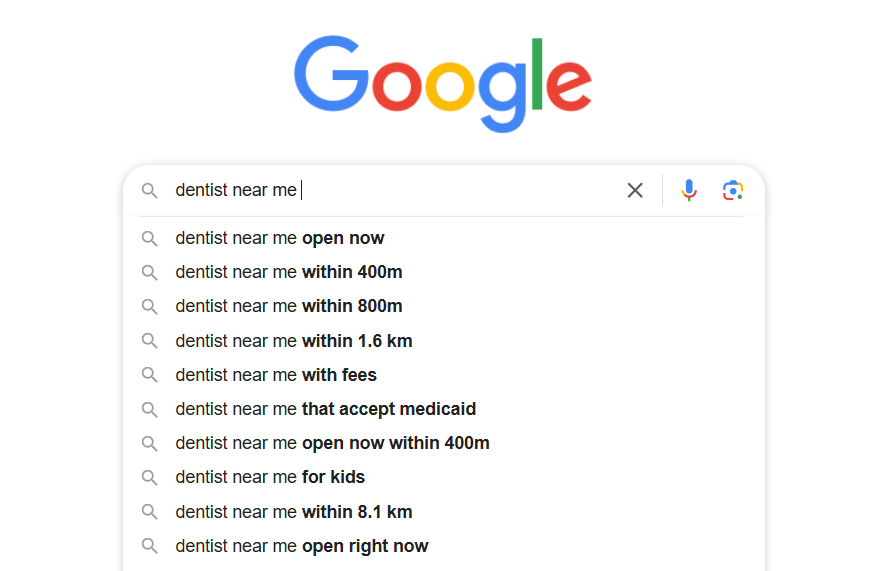
With the help of keyword research, you can uncover what words and phrases patients use to search for dentists around them. Your keyword strategy will not just revolve around keywords like “dentist [CITY]” or “dentist near me.”
At times, patients want to investigate an issue or a procedure before scheduling an appointment.
For example, a potential client wanting to undergo teeth whitening in Los Angeles might search for “teeth whitening Los Angeles” to find out which dentists perform the procedure. Others may want to learn more about the procedure before their appointment so that they are prepared.
Pick keywords you can and want to rank for, especially ones that are low-hanging fruits like having low keyword difficulty and high search volume.
2. Google Business Profile listing needs to be claimed
The practice of dentistry operates on physical, in-person visits, which makes Google Business Profile crucial. A Google Business Profile shows up in localized or branded searches and enables people to see a business’s phone number, address, and working hours.
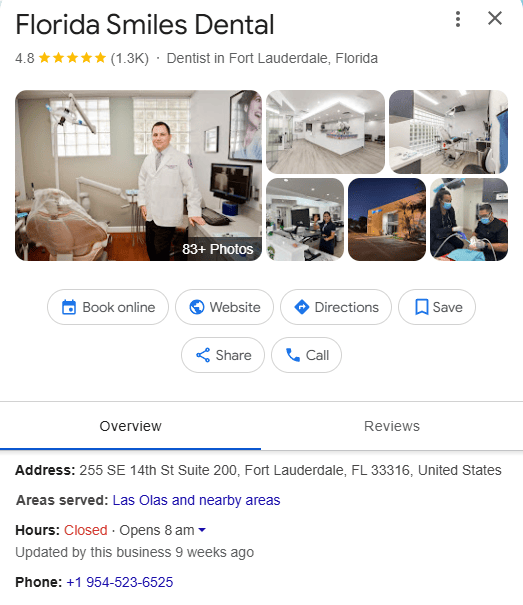
People can access this listing to read reviews, FAQs, and even view photos, services, and other relevant information. After verifying your Google Business Profile, you can provide users with:
- How to contact you
- Where to find you
- How you can help
- And more
Other local listings, such as Bing Places, can also be verified to expand your online presence.
3. Enroll in local directory listings for your dental practice.
After completing the Google Business Profile, the next step is to enroll your dental practice in local directory listings and optimize your citations, or references online with your business’s contact information.
The national review platforms and the local chamber of commerce listing are all part of the growing list. Yelp and Zocdoc are wonderful platforms where prospective patients can locate your practice, so be sure to add your practice.
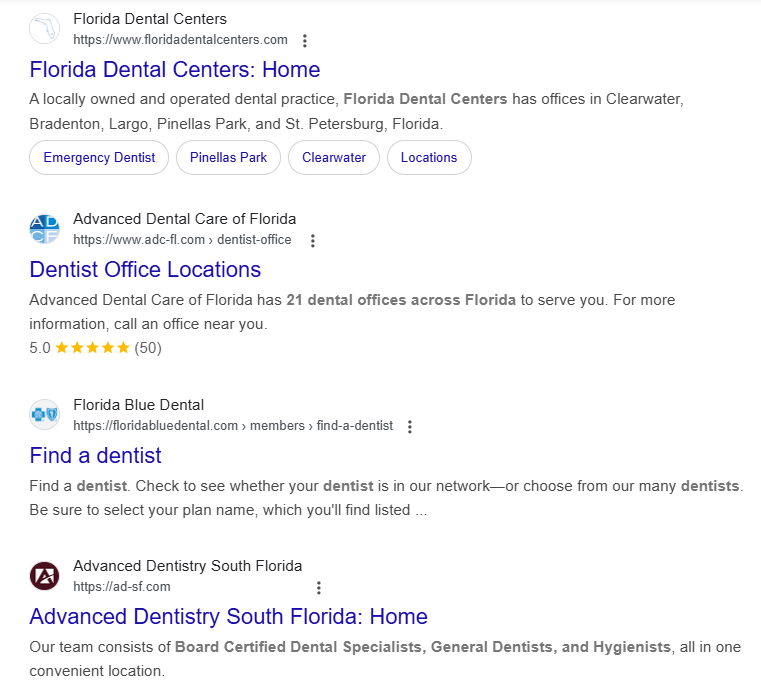
Moreover, be sure to update your listing and review information on Healthgrades, RateMDs, and other healthcare review platforms that patients can access and read about the experiences and reviews on the services offered.
A Healthgrades dentist profile like this example gives a snapshot about the doctor: his background, where he practices, the insurance he works with, and what patient feedback says.
4. Develop Opportunities to Gain Links
Backlinks, which are essentially links from one website to another, are essential to dental SEO. As such, link acquisition opportunities should be incorporated in your dental SEO efforts. Dental practices can build these opportunities in a few ways, like through:

- Providing a dental implants calculator
- Producing user-focused articles explaining new procedures for patients
- Conducting polls to help people understand why they fear the dentist
Tune up with your staff and find useful ideas for your practice. Some tools, such as an online calculator, will require a computer technician. If such a technician isn’t readily available, think about using an agency, a contractor, or a freelancer.
5. Improve the overall page experience for your site users
Page experience includes several elements. A few examples include:
- Readability
- Usability
- Accessibility
Most likely, to achieve an optimized page experience, you will need the help of a graphic designer and a webpage developer. If you use website builders such as Squarespace, you will find that they provide already optimized templates for these features.
If you’re not using a website builder, consider working with an SEO web design agency like SwiftPropel. Their expertise in search engine optimization and web design makes them capable of applying critical SEO strategies during the redesign process.
6. Optimize your site for mobile users
Having a mobile-friendly website is no longer optional. Google alone processes 8.5 billion searches a day, and 63% of the traffic is from mobile devices.
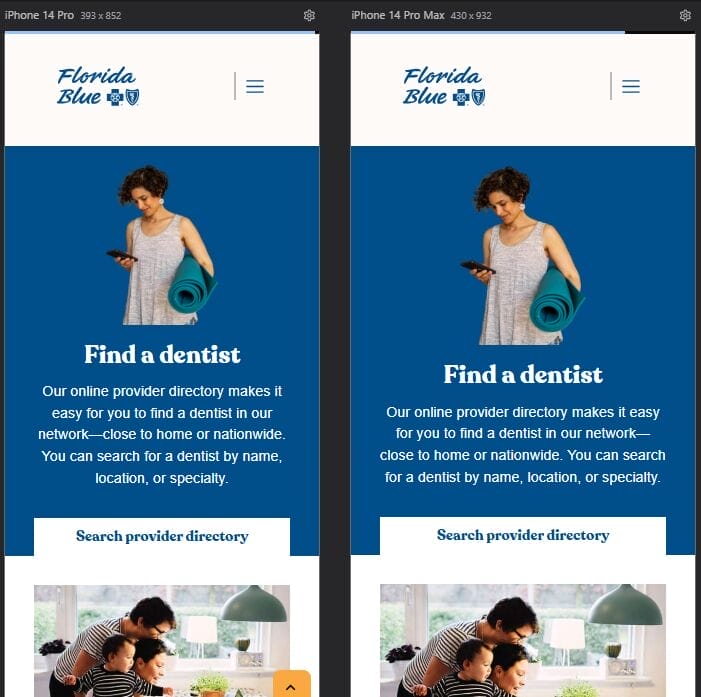
Visitors will contact a local business if its website has mobile-friendly features. In fact, 67% of mobile searchers are likely to get in touch with a local business if its website is mobile-friendly.
Offering an efficient user experience to mobile searchers makes them easily findable and reachable. This decreases the number of steps a user has to go through to find contact details, which increases the chances of them booking an appointment.
7. Check For Errors in Technical SEO
Technical SEO constitutes 30-40% of your SERP ranking. It involves setting specific features of the website, such as page load speed and layout, in a way that makes it simple for search engines to access and crawl the processes on the site. Websites that load quickly and have clear paths for crawlers tend to rank higher.
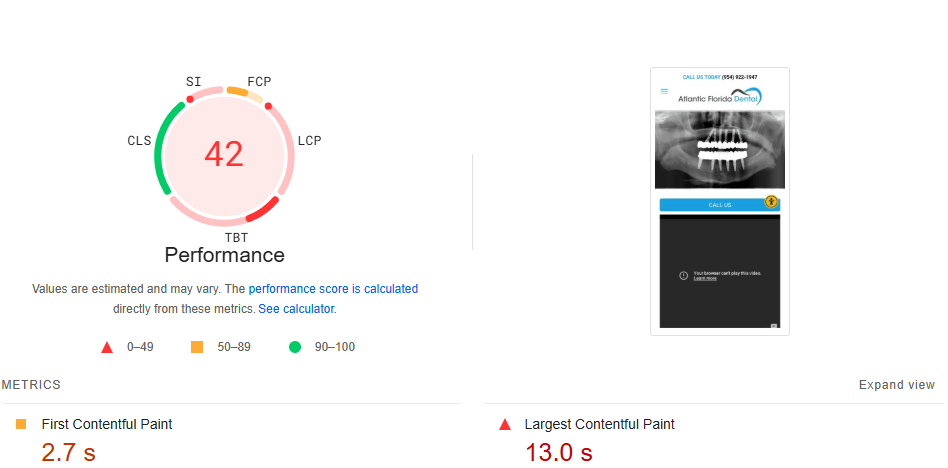
Google and other search engines try to provide the most relevant content for their users’ queries. Your website is less likely to be considered relevant if it bounces visitors because it doesn’t load quickly. A technically optimized site should:
Remember to perform these steps for each of your pages:
- Ensure high-speed loading.
- Ensure access for search engines.
- Include a robots.txt file.
- Remove any dead links.
- Enable to edit redundant content.
- Ensure SSL/HTTPS security.
- Implement structured data.
- Provide a site map.
If you don’t recognize these factors, it’s alright. Feel free to seek out experts if you have no interest in the topic. Get in touch with your web development team to evaluate your website’s technical condition or as an alternative, use any available online tools to perform a technical audit of your website. You can also carry out a technical audit here.
8. Blogging as an SEO Strategy
Dentists have found having a blog is very beneficial for SEO. With such content, potential patients begin to view the practitioner as a credible source. Google also recognizes this and views it as proof that you are indeed adding value. This process in turn will increase your ranking in page results. The best dental SEO services always leverage blog posts.
The first thing you need to do is add a blog to your website. A dental blog can easily be integrated along with the rest of the components in only a few minutes. Thereafter, post unique content as often as you can. I recommend making your blog posts as detailed as possible; each post should be a minimum of 650 words.

Patients searching for a dentist will use geographically specific locators to find their selected service. It is ideal for a dental website to be optimized around such geo-locators because it allows patients and search phrases to link easily through Google’s myriad services.
To boost your dental copywriting, you must append the city, state, and specific services into your text. Do not forget to draft a plan with your dental SEO strategy about keyword mapping, too.
9. Populate Your Practice’s Social Media Regularly
It is interesting to note that your social media accounts, like Instagram and Facebook, are treated as other platforms where activity is observed for ranking purposes. You can already see the link between social media marketing and SEO for dentists. Active social media accounts are one more avenue for improving your Google ranking.
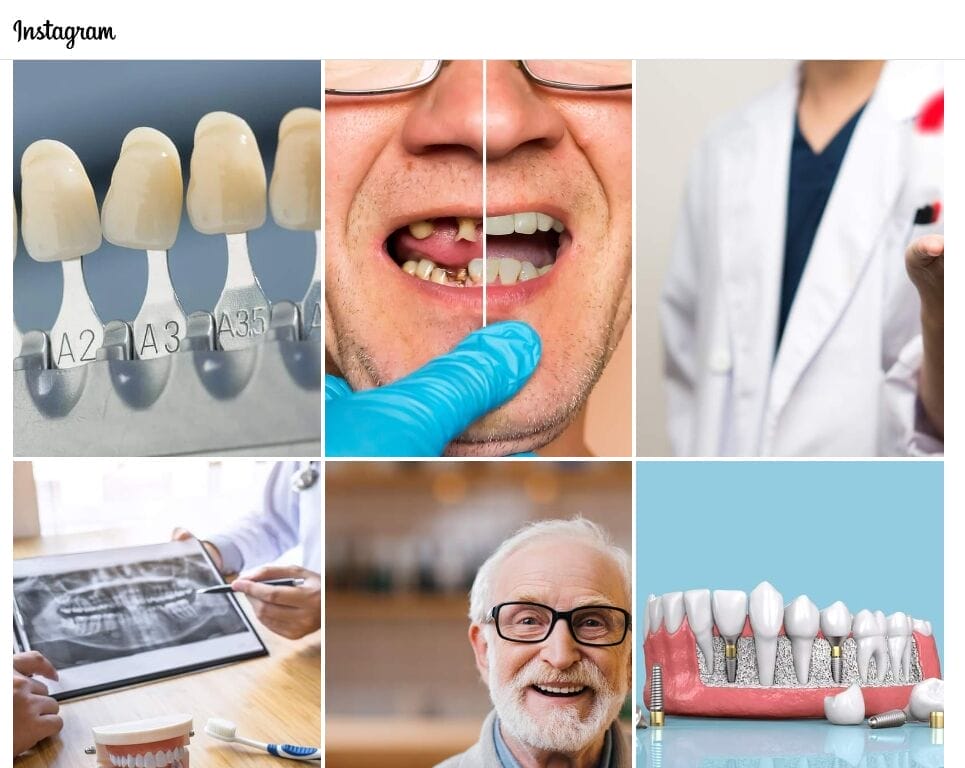
Whenever you share or post on Facebook, Instagram, TikTok, LinkedIn, or any other social media platform, your followers can comment, share, and even like the post. Such activity is referred to as engagement on social media. It is easily identifiable by search engines, which aids in distinguishing the key players or authorities in a niche.
10. Strengthen your internal linking strategy
Internal links are links from your website to another page on your website. A good illustration would be a blog post discussing dental implants that links to the dental implant service page of your website.
Can you shed some light on why internal links are important? Search engine spiders rely on a website’s internal links to uncover all its pages because that is how they can access the website’s hierarchical structure. A new page can only be indexed if it is accessible through its links.
The defeatist approach of hiding or obscuring primary navigational links to central webpages is one of the most foreboding mistakes many websites make. This, in turn, minimizes their probability of being scanned and indexed by search engines.
Moreover, having a website does not automatically guarantee that Google knows who your target audience is. Internal links help to address this issue by guiding your links to show Google what services are vital to your practice.
How can dentists know if SEO is working?
Measuring the outcome of your marketing strategies is crucial to an effective dental practice SEO. Here are the most significant metrics to consider:
Conversions—The specific step you would like a prospective patient to take. We suggest calls, form fills, online appointment scheduling, chatbot interactions, and driving directions.
Website traffic—Analyze the clients visiting your page and the area they are coming from.
Keyword rankings—Assess your position and page ranking for each of your keywords and how it fluctuates over time.
Reviews—Ensure this number is constantly improving and remember to reply to your patients’ feedback.
Advantages of local SEO for dentists
Local SEO utilizes a more defined approach to capture targets within a certain location.
Local search helps dentists with a physical dental practice to attract more patients within their city and neighboring regions. Let’s discuss some advantages of implementing a local SEO plan for your dental practice.
1. Enhance presence on the internet
To optimize webpages and local listings to target prospective patients in the area, it is essential to increase presence on the internet.
2. Surge in the number of dental patients
Using local strategies can increase relevant visitors to your website, some of whom may convert into clients. Your online visibility directly correlates with the number of patients you can attract to your clinic.
3. Establish credibility and a good image
Reviews are the most important part of any local SEO strategy. About 75% of clients look at reviews when searching for a business online.
Creating reviews for your dental practice will help garner trust from search engine users, thereby enhancing local visibility and reputation.
Conclusion
The content of this article demonstrates that implementing a suitable SEO strategy can significantly enhance a dental practice’s digital visibility and patient traffic. By concentrating on content marketing, local SEO, and online reputation management, and taking proactive steps to deepen their coverage, dental practices may compete more effectively and earn greater patient volumes.
Moreover, keep pace with new developments across dental SEO technologies like voice search and mobile-first indexing. Applying these effective SEO strategies will enhance the visibility of your practice and make you easily accessible to patients seeking dental care. With the right focus and approaches, dedicated dentists can overcome challenges in digital visibility.

Komal is a dynamic and results-driven digital marketing professional with a passion for leveraging innovative strategies to drive business growth. Her expertise spans across social media marketing, content creation, SEO optimization, and data analytics, making her a valuable asset in the ever-evolving digital landscape.