Be******ape, a Manali-based travel package brand, needed a paid acquisition system to generate enquiries for domestic travel packages.
SwiftPropel built and managed the Meta Ads account from scratch from January 2026 to June 2026.
The business objective was lead generation for travel packages.
The account was not built around one generic “travel leads” campaign. Travel demand is destination-led. A user interested in Ladakh does not behave the same way as someone exploring Himachal, Kashmir, Kerala, Rajasthan, Uttarakhand, or tribal circuit packages.
SwiftPropel’s strategy was to test destination-level demand first, then scale the strongest acquisition paths using video-led creative, Meta instant forms, website lead forms, and retargeting.
The Challenge
Travel-package campaigns have a specific funnel problem.
Most users are not ready to pay immediately after seeing one ad. They first compare:
- Destination
- Travel dates
- Package inclusions
- Budget
- Visual appeal
- Route and itinerary
- Trust in the operator
- Ease of enquiry
A generic campaign would have blurred all destination intent into one bucket.
The account needed to identify which destinations could generate enquiry volume, reduce friction for mobile users, and move interested travellers into a lead-capture path.
The client did not provide downstream lead status, package pricing, confirmed booking data, payment status, revenue, or ROAS. Therefore, this case study reports platform-reported result events and website-side engagement, not final travel bookings.
The Strategic Premise
The campaign was built around one principle:
Travel leads scale better when destination intent, visual storytelling, and enquiry friction are handled separately.
The acquisition model was:
Destination interest → visual package appeal → low-friction form capture → retargeting support
Campaign Architecture
SwiftPropel built and managed campaigns across four layers:
| Campaign Layer | Role |
|---|---|
| Destination-specific campaigns | Test demand for individual travel destinations |
| Video-led lead campaigns | Use visual creative to create stronger package appeal |
| Meta instant forms | Reduce mobile enquiry friction |
| Website form campaigns | Capture users willing to enquire on the website |
| Retargeting | Re-engage users who had interacted with ads or website assets |
Destination campaigns included:
- Himachal
- Ladakh
- Kashmir
- Rajasthan
- Kerala
- Tribal Circuit
- Uttarakhand
This allowed SwiftPropel to test demand by travel theme before scaling into larger video-led acquisition campaigns.
Strategy
1. Start with destination-specific lead testing
The first phase tested individual destination campaigns.
This gave the account early data on which travel themes could generate enquiry activity at a controlled cost.
| Destination Campaign | Reported Results | Spend | Cost per Result |
|---|---|---|---|
| Ladakh | 21 | ₹2,023.93 | ₹96.38 |
| Uttarakhand | 20 | ₹2,377.30 | ₹118.87 |
| Himachal | 15 | ₹2,185.50 | ₹145.70 |
| Kashmir | 14 | ₹2,000.92 | ₹142.92 |
| Kerala | 12 | ₹1,977.45 | ₹164.79 |
| Tribal Circuit | 10 | ₹2,023.13 | ₹202.31 |
| Rajasthan | 9 | ₹2,032.17 | ₹225.80 |
Together, these destination tests generated 101 reported result events from ₹14,620.40 in spend.
The purpose of this phase was learning, not scale.
2. Shift into video-led acquisition
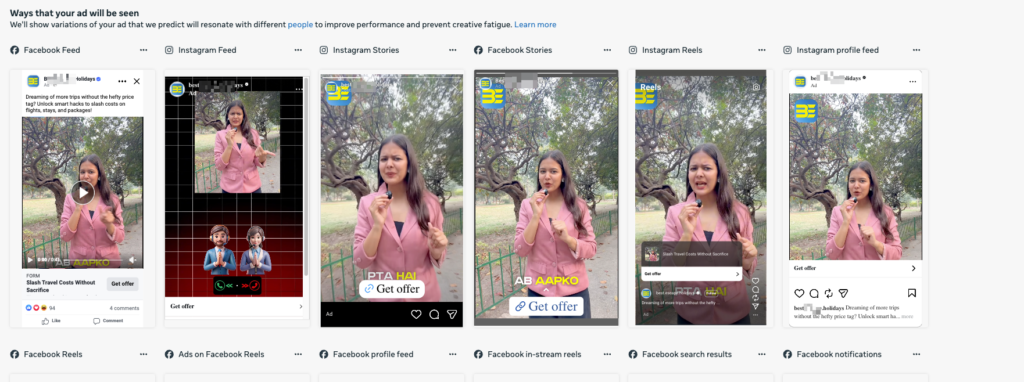
Travel is visual. Static destination messaging has limited persuasive power compared with video creative that shows the experience, landscape, and package appeal.
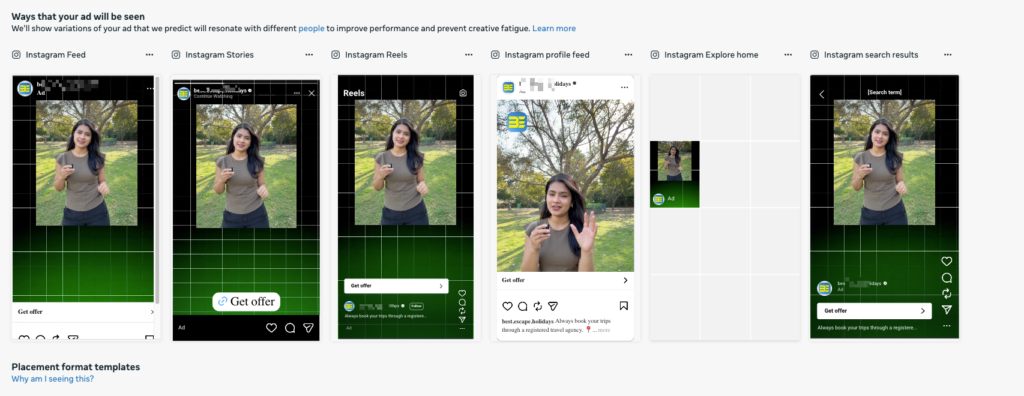
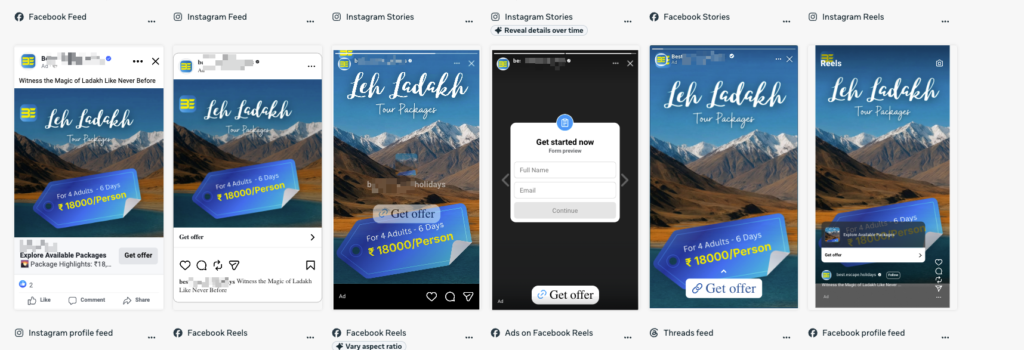
SwiftPropel shifted budget toward video-led campaigns once early destination testing had provided directional learning.
The strongest campaign in the account was the video-led instant-form campaign launched on March 26, 2026.
| Campaign | Reported Results | Spend | Cost per Result |
|---|---|---|---|
| Video Ad_Leads_Instant Forms_26 Mar 2026 | 1,260 | ₹167,434.58 | ₹132.88 |
This campaign became the main scale driver.
It produced the majority of the account’s reported result events while keeping cost per result controlled.
3. Use Meta instant forms to reduce mobile friction
The GA4 data showed the website experience was heavily mobile and in-app driven, with Android WebView accounting for the largest share of active users.
That made instant forms commercially useful.
A mobile user interested in a travel package may not want to browse multiple pages before enquiring. Meta instant forms reduced the number of steps between interest and submission.
| Lead Capture Type | Reported Results | Spend | Cost per Result |
|---|---|---|---|
| Meta instant-form campaigns | 1,480 | ₹191,657.05 | ₹129.50 |
| Website-form campaigns | 232 | ₹28,706.04 | ₹123.73 |
| Other Meta lead campaign | 58 | ₹3,032.03 | ₹52.28 |
| Retargeting campaigns | 62 | ₹32,524.12 | ₹524.59 |
Instant forms became the primary scale mechanism.
Website forms supported users who were willing to complete an enquiry on the site.
4. Keep retargeting as a support layer, not the headline win
Retargeting was tested, but the export does not support positioning retargeting as the main success story.
The defensible interpretation is:
- Destination campaigns helped identify demand pockets.
- Video-led campaigns created scale.
- Instant forms reduced enquiry friction.
- Retargeting supported the funnel but was not the strongest efficiency driver.
Meta Ads Results
Reporting period: January 1, 2026 to June 30, 2026
Platform: Meta Ads
Objective: Travel package lead generation
| Metric | Result |
|---|---|
| Total Meta Ads spend | ₹255,921.24 |
| Impressions | 606,412 |
| Aggregate campaign-level reach | 381,258 |
| Clicks | 21,751 |
| Weighted CTR | 3.59% |
| Average CPC | ₹11.77 |
| Platform-reported result events | 1,832 |
| Blended cost per result | ₹139.70 |
| Video plays | 517,187 |
Lead Event Breakdown
| Result Type | Reported Result Events |
|---|---|
| Meta instant-form lead events | 1,512 |
| Website custom-conversion lead events | 232 |
| Meta lead events | 58 |
| Grouped pixel custom-conversion events | 30 |
| Total reported result events | 1,832 |
The 1,832 figure is the primary Meta Ads performance claim.
It should not be described as 1,832 bookings, confirmed customers, or paid travellers.
Campaign-Level Performance
| Campaign | Reported Results | Spend | Cost per Result |
|---|---|---|---|
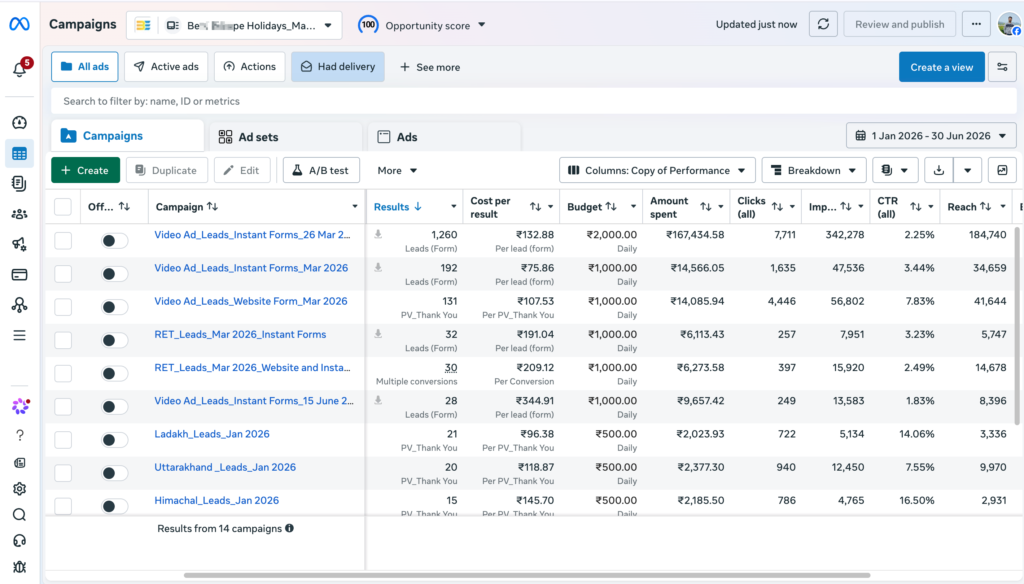
| Video Ad_Leads_Instant Forms_26 Mar 2026 | 1,260 | ₹167,434.58 | ₹132.88 |
| Video Ad_Leads_Instant Forms_Mar 2026 | 192 | ₹14,566.05 | ₹75.86 |
| Video Ad_Leads_Website Form_Mar 2026 | 131 | ₹14,085.94 | ₹107.53 |
| Dhruti | 58 | ₹3,032.03 | ₹52.28 |
| RET_Leads_Mar 2026_Instant Forms | 32 | ₹6,113.43 | ₹191.04 |
| RET_Leads_Mar 2026_Website and Instant Forms | 30 | ₹6,273.58 | ₹209.12 |
| Video Ad_Leads_Instant Forms_15 June 2026 | 28 | ₹9,657.42 | ₹344.91 |
| Ladakh_Leads_Jan 2026 | 21 | ₹2,023.93 | ₹96.38 |
| Uttarakhand_Leads_Jan 2026 | 20 | ₹2,377.30 | ₹118.87 |
| Himachal_Leads_Jan 2026 | 15 | ₹2,185.50 | ₹145.70 |
GA4 Website Engagement Context
GA4 was reviewed to understand what happened on the website during the campaign period.
From January 1 to June 30, 2026, the website recorded:
| GA4 Metric | Result |
|---|---|
| Total sessions | 10,120 |
| Engaged sessions | 4,902 |
| Engagement rate | 48.44% |
| Total page views | 19,903 |
| Active users | 9,282 |
| Total events | 56,849 |
| Key events | 0 |
| Revenue | ₹0 |
Paid Social was one of the strongest website traffic sources.
| Channel | Sessions | Engaged Sessions | Engagement Rate | Event Count |
|---|---|---|---|---|
| Organic Social | 4,218 | 1,927 | 45.69% | 20,995 |
| Paid Social | 3,794 | 1,854 | 48.87% | 19,109 |
| Organic Search | 1,242 | 836 | 67.31% | 10,290 |
| Direct | 830 | 310 | 37.35% | 4,717 |
Paid Social generated 37.49% of all website sessions during the period.
This supports the Meta Ads story because campaign traffic was not confined to the Meta platform. Users also reached the website, viewed destination pages, started forms, submitted forms, and triggered contact events.
Destination Page Engagement
The website data supported the destination-led campaign strategy.
| Page Path | Views | Active Users | Strategic Role |
|---|---|---|---|
| /all-destinations-list/ | 5,386 | 3,858 | Main destination browsing hub |
| / | 2,324 | 916 | Homepage discovery |
| /destination/himachal-pradesh/ | 1,495 | 795 | Himachal package interest |
| /destination/jammu-kashmir/ | 1,004 | 608 | Kashmir package interest |
| /destination/uttarakhand/ | 996 | 682 | Uttarakhand package interest |
| /destination/rajasthan/ | 949 | 627 | Rajasthan package interest |
| /destination/tribal-circuit/ | 928 | 583 | Tribal Circuit package interest |
| /destination/leh-ladakh/ | 921 | 593 | Ladakh package interest |
| /destination/kerela/ | 775 | 515 | Kerala package interest |
| /contact/ | 682 | 509 | Contact and enquiry path |
| /thank-you/ | 504 | 376 | Post-submit confirmation path |
The strongest page was the all-destinations listing page, followed by the homepage and individual destination pages.
This supports the campaign architecture: users were exploring destination-specific content rather than only visiting a generic landing page.
Website Form and Contact Activity
GA4 recorded the following website-side events:
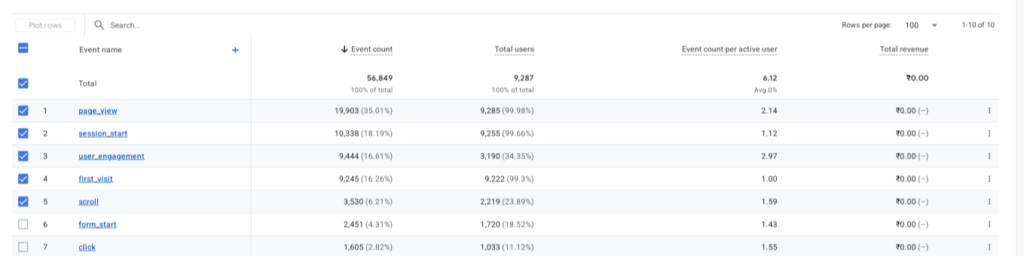
| Event | Count |
|---|---|
| page_view | 19,903 |
| session_start | 10,338 |
| user_engagement | 9,444 |
| first_visit | 9,245 |
| scroll | 3,530 |
| form_start | 2,451 |
| click | 1,605 |
| contact | 219 |
| form_submit | 113 |
These website-side events support the presence of enquiry behaviour.
However, they should not be merged with the Meta result total. Meta Ads Manager remains the source of truth for platform-reported result events. GA4 is used only as website engagement context.
Geographic Context
The campaign and website activity were heavily India-focused.
| Country | Active Users | Engagement Rate | Event Count |
|---|---|---|---|
| India | 8,617 | 50.29% | 53,270 |
| United States | 382 | 34.81% | 1,386 |
| Singapore | 153 | 3.27% | 474 |
India accounted for 92.84% of active users.
That aligns with the business context: Client was selling domestic travel packages from India.
Mobile and In-App Behaviour
The user environment was heavily mobile and in-app.
| Browser / Environment | Active Users | Share of Active Users |
|---|---|---|
| Android WebView | 7,116 | 76.66% |
| Chrome | 1,395 | 15.03% |
| Safari | 679 | 7.32% |
Android WebView dominance is important because many Meta users open landing pages inside an in-app browser.
That supports the use of Meta instant forms and mobile-first creative. A lower-friction form path was commercially logical because a large share of users were likely browsing from mobile app environments.
What Worked
The strongest performance pattern was:
Destination testing → video-led demand creation → instant-form lead capture → website destination exploration
Destination tests gave early direction.
Video-led creative created scale.
Instant forms reduced mobile enquiry friction.
Website analytics confirmed that users were exploring destination pages, starting forms, submitting forms, and reaching contact paths.
The strongest campaign was the March 26 video-led instant-form campaign, which generated 1,260 reported result events from ₹167,434.58 in spend.
What Should Not Be Claimed
The client did not provide:
- Package pricing
- Lead qualification status
- Follow-up outcome
- WhatsApp conversation outcomes
- Sales-call outcome
- Confirmed booking status
- Payment status
- Travel package revenue
- ROAS
- Cancellation data
- Repeat customer value
Therefore, this case study does not claim:
- Confirmed bookings
- Paying travellers
- Qualified lead volume
- Revenue generated
- Return on ad spend
- Cost per booking
- Cost per sale
Measurement Note
The 1,832 result figure represents Meta platform-reported result events.
It includes instant-form leads, website custom-conversion lead events, Meta lead events, and grouped pixel custom-conversion events.
It is not presented as confirmed bookings, package sales, or revenue.
GA4 recorded 113 form_submit events, 2,451 form_start events, and 219 contact events during the same period. These are useful website-side engagement signals.
Key Lesson
For travel package lead generation, generic campaign structure is weak.
People choose trips by destination, emotion, visuals, itinerary, and timing. A campaign that treats Himachal, Ladakh, Kashmir, Rajasthan, Kerala, Uttarakhand, and tribal circuit packages as one generic offer will lose relevance.
The stronger model is:
- Test destination-level demand first.
- Use video to make the package tangible.
- Use instant forms to reduce mobile friction.
- Use website forms for users who prefer deeper exploration.
- Use retargeting as a support layer, not as the core performance claim.
- Keep platform-reported leads separate from confirmed bookings and revenue.
SwiftPropel’s campaign created a destination-led Meta acquisition engine that generated 1,832 platform-reported result events from ₹255.9K in spend, while GA4 confirmed meaningful website activity across destination pages, form starts, form submits, and contact paths.
Engagement Type
Meta Ads account buildout, destination-specific campaign testing, video-led lead campaigns, instant-form lead generation, website-form lead generation, retargeting, campaign budget management, creative testing, mobile-first funnel strategy, destination-page performance review, GA4 traffic analysis, and performance reporting.
Need travel ads that do more than push generic package offers?
SwiftPropel builds paid acquisition systems that connect destination interest, video creative, mobile-first lead capture, website exploration, and measurable enquiry actions into one structured growth engine.

Vijay Sood is a seasoned digital marketer with a passion for driving online growth and innovation. With a robust background in developing and executing comprehensive digital strategies, Vijay excels in leveraging SEO, content marketing, and social media to boost brand visibility and engagement. His expertise lies in transforming data-driven insights into actionable marketing campaigns, helping businesses achieve their digital objectives.