
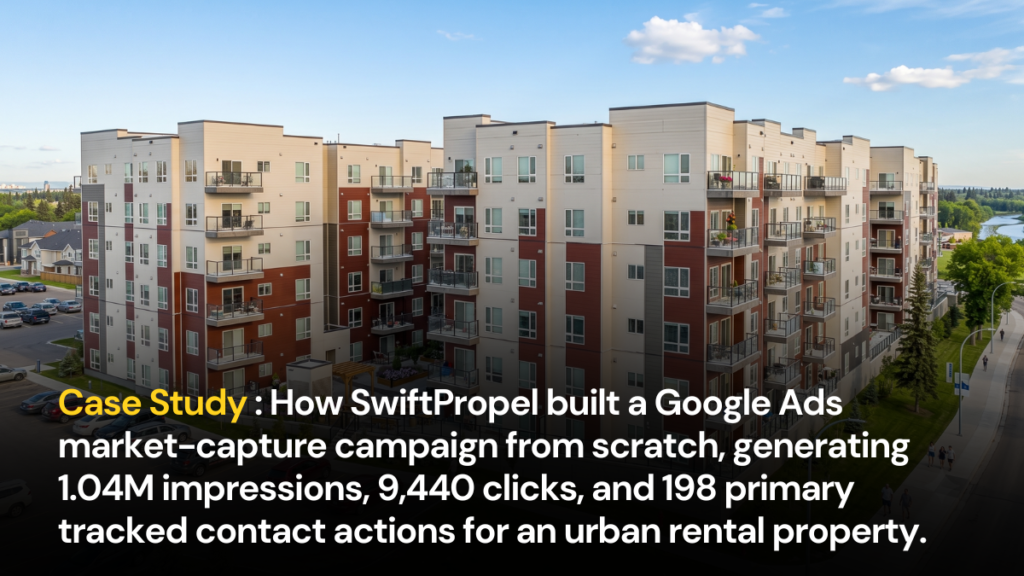
SwiftPropel was engaged as a white-label Google Ads partner to build a rental-enquiry campaign from scratch for an urban multifamily rental property.
The objective was not simply to appear for generic apartment searches.
The property needed to compete across the full rental search market:
- Renters searching broadly for apartments
- Prospects looking for affordable rental options
- People searching by location
- Renters comparing nearby properties
- Website visitors returning to review floorplans, galleries, and building information
- Prospects ready to submit a form, call, or click into a direct contact path
SwiftPropel built the account around that competitive reality.
The Strategic Problem
Rental demand does not arrive through one keyword.
A prospective tenant may begin with a broad search such as “apartments for rent,” narrow the search by budget or neighbourhood, compare several rental communities, then revisit floorplans before contacting the leasing team.
A generic Search campaign would miss much of that journey.
A Display-only campaign could generate awareness but would not reliably capture high-intent rental demand.
The account needed to balance three jobs:
- Capture active apartment-search demand
- Enter the consideration set when renters compared alternatives
- Create measurable direct-contact opportunities through forms, calls, and phone clicks
The Market-Capture Strategy
1. Capture category demand
Search campaigns targeted renters actively looking for apartments, including broad rental searches, location-based searches, affordability-related searches, and apartment-for-rent demand.
The purpose was to capture demand already present in the market rather than wait for renters to discover the property organically.
2. Compete during the comparison stage
The search landscape showed that renters were not only looking for apartments generally. They were also comparing specific local rental options.
SwiftPropel used competitor-focused targeting to enter that comparison moment.
This gave the property visibility when a renter had already shown intent to evaluate alternatives rather than only when they searched for generic apartment terms.
3. Use each campaign type for a different job
The account was structured so that campaign types did not compete for the same role.
| Campaign Layer | Role in the Rental Journey |
|---|---|
| Search | Capture active apartment and rental demand |
| Performance Max | Extend demand capture across Google inventory |
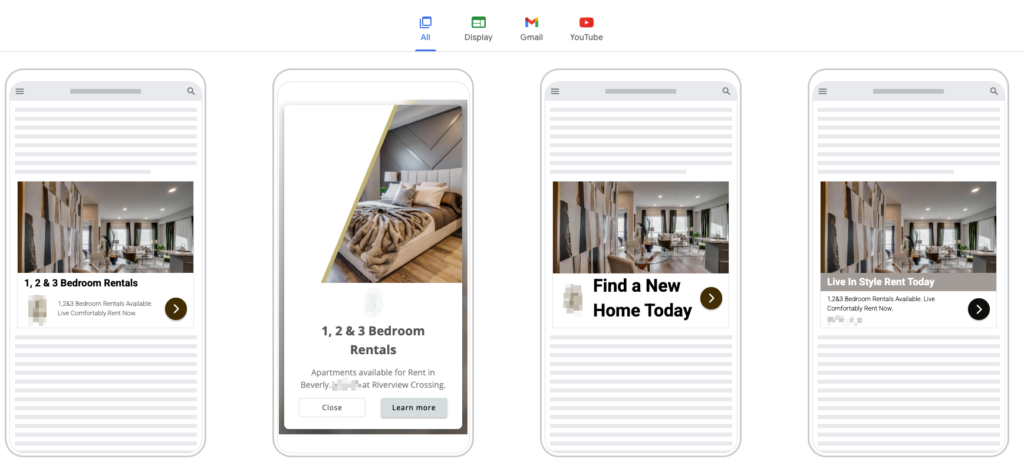
| Display | Build visibility and support property discovery |
| Remarketing | Re-engage previous website visitors |
| Competitor campaigns | Reach renters comparing local alternatives |
| Call ads | Create a direct phone-contact route |
This structure gave SwiftPropel more control over budget allocation, reporting, and optimization than a single broad campaign.
4. Build measurable contact paths
The website used a WordPress form, allowing SwiftPropel to track submitted form activity.
The account also tracked direct-contact actions separately:
- Website form submissions
- Google-hosted lead-form submissions
- Calls from ads
- Website phone-number clicks
This made it possible to distinguish direct contact activity from softer engagement such as website visits, address clicks, and email clicks.
5. Optimize around market signals
Ongoing management focused on improving relevance and controlling wasted spend through:
- Search-term analysis
- Negative keyword refinement
- Keyword expansion
- Competitor monitoring
- Bid-strategy review
- Ad-copy refinement
- Performance Max optimization
- Display and remarketing audience review
- Device-performance analysis
- Geographic targeting adjustments
- Dayparting review
- Budget reallocation
- Campaign and ad-group restructuring
The objective was to improve the property’s position across the rental market, not simply add more keywords.
Results
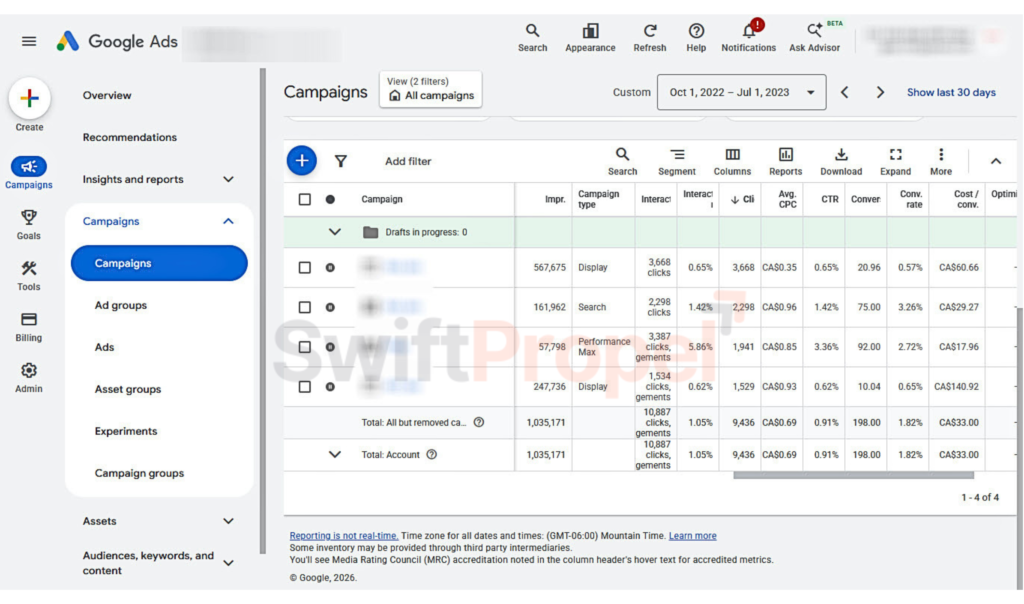
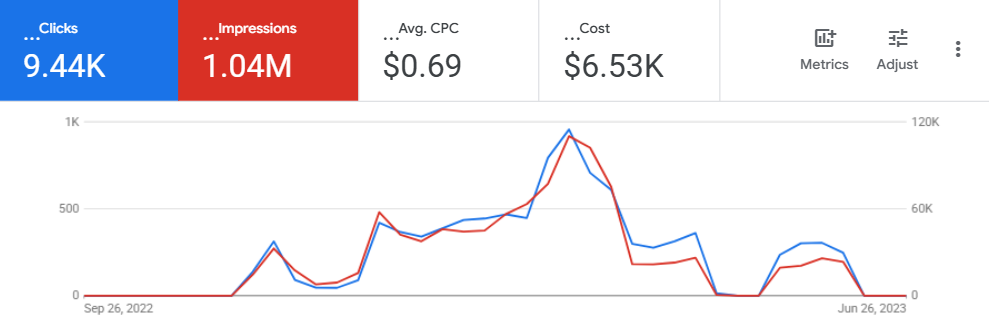
Campaign period: October 1, 2022 to July 1, 2023
| Metric | Result |
|---|---|
| Google Ads spend | CA$6.53K |
| Impressions | 1.04M |
| Clicks | 9.44K |
| Average CPC | CA$0.69 |
| Primary tracked contact actions | 198 |
| Cost per primary tracked contact action | CA$33.00 |
| Tracked WordPress form submissions | 65 |
| Google-hosted lead-form submission | 1 |
| Calls from ads | 17 |
| Website phone-number click actions | 115 |
What Drove the Direct-Response Results
The account’s strongest primary-action efficiency came from intent-led campaigns.
| Campaign Type | Primary Tracked Actions | Cost per Primary Action |
|---|---|---|
| Search | 75 | CA$29.27 |
| Performance Max | 92 | CA$17.96 |
| Display and remarketing combined | 31 | CA$86.65 |
Search and Performance Max generated 167 of the account’s 198 primary tracked contact actions.
That matters because it showed where the account was producing the strongest measurable direct-response activity, while Display and remarketing maintained a separate role in discovery, visibility, and re-engagement.
Renter Research Context
The paid campaign supported a website where renters were actively researching apartment options.
During the reporting period, the website recorded strong engagement with:
- Floorplans
- Gallery content
- Building information
- Amenities
- Contact pages
- Individual apartment layouts
- Book-a-tour pages
- Neighbourhood content
Floorplans were one of the most important research assets on the site, indicating that renters were moving beyond the homepage and evaluating specific apartment options before entering a contact path.
What the Results Mean
With CA$6.53K in media spend, SwiftPropel generated:
- More than 1 million impressions
- More than 9,400 clicks
- CA$0.69 average CPC
- 66 tracked form-submission events
- 17 calls directly from ads
- 115 website phone-number click actions
- 198 total primary tracked contact actions
The campaign did not depend on one generic apartment keyword or one conversion source.
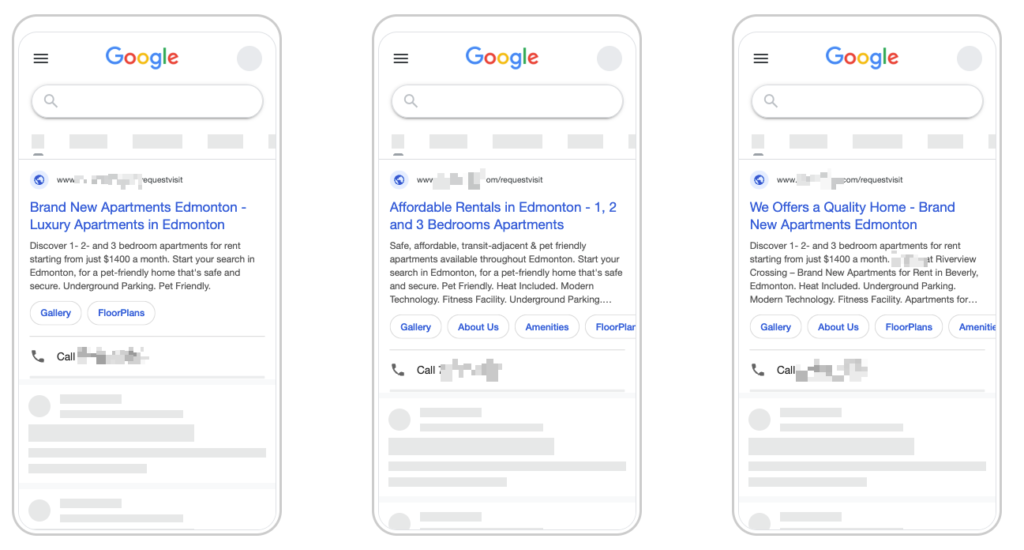
It created visibility across the rental market, captured active search demand, entered competitor comparison moments, and moved interested renters into measurable contact paths.
Measurement Note
The account recorded 366 total conversion actions during the reporting period.
That total should not be treated as 366 leads.
It included a mix of direct-contact actions and secondary actions, including:
- Form submissions
- Calls from ads
- Phone-number clicks
- Email clicks
- Address clicks
- Other website engagement actions
For reporting accuracy, SwiftPropel separates the direct-response activity as follows:
| Action Type | Reported Result |
|---|---|
| Tracked WordPress form submissions | 65 |
| Google-hosted lead-form submissions | 1 |
| Calls from ads | 17 |
| Website phone-number clicks | 115 |
| Primary tracked contact actions | 198 |
SwiftPropel did not have CRM or leasing-platform access. Therefore, this case study does not claim qualified leads, completed tours, rental applications, signed leases, revenue, or occupancy gains.
Key Lesson
In a competitive rental market, generic keyword coverage is not enough.
Renters search across a consideration set:
- Broad apartment terms
- Price and affordability terms
- Neighbourhood terms
- Competitor properties
- Unit and floorplan options
- Contact and tour paths
The account performed because it was built to capture that full market, not just one narrow search behavior.
The strategic advantage was not merely lower-cost clicks.
It was creating a structured system that moved renters from market discovery to property research to measurable contact intent.
Engagement Type
White-label Google Ads strategy, account buildout, Search campaigns, Performance Max, Display campaigns, remarketing, competitor targeting, call ads, WordPress form-conversion tracking, keyword expansion, negative-keyword management, bid-strategy testing, campaign restructuring, budget allocation, and ongoing performance reporting.
Need a Google Ads system that helps your rental property compete across the full search market, not just generic apartment keywords?
SwiftPropel builds paid acquisition systems that connect market demand, competitor comparison, renter research, and measurable contact actions into one structured growth engine.

Vijay Sood is a seasoned digital marketer with a passion for driving online growth and innovation. With a robust background in developing and executing comprehensive digital strategies, Vijay excels in leveraging SEO, content marketing, and social media to boost brand visibility and engagement. His expertise lies in transforming data-driven insights into actionable marketing campaigns, helping businesses achieve their digital objectives.