
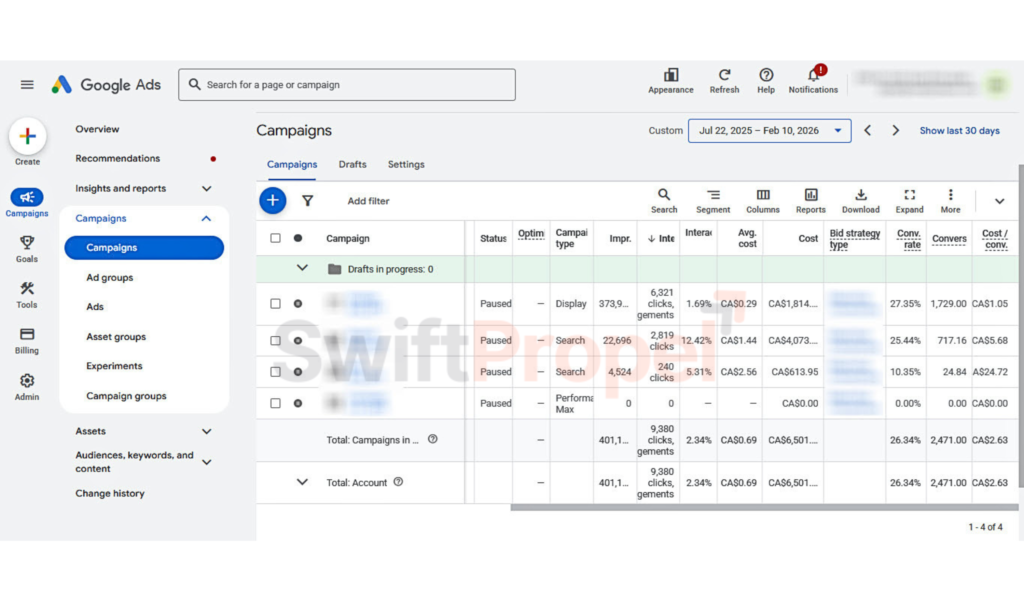
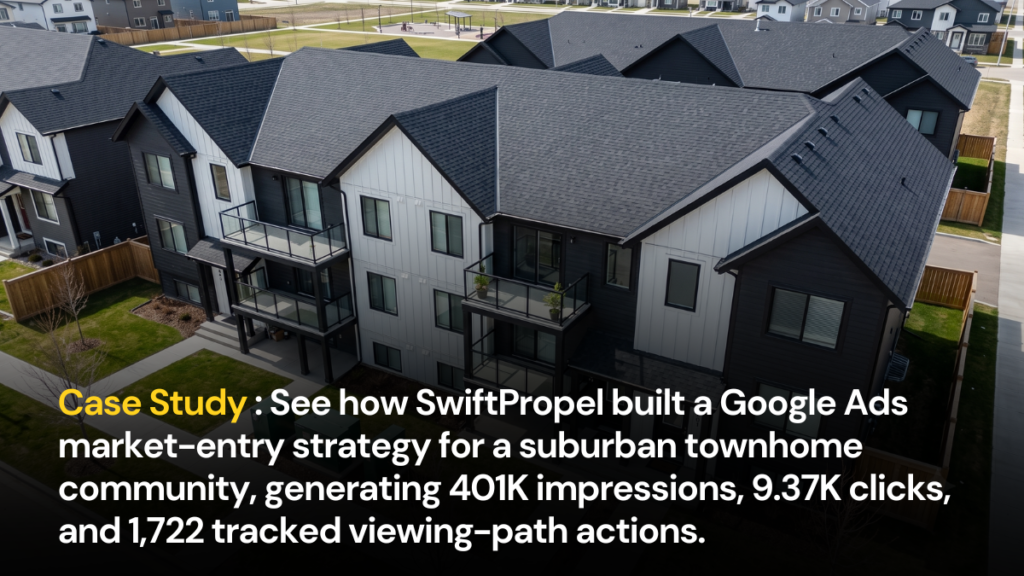
See how SwiftPropel built a Google Ads market-entry strategy for a suburban townhome community, generating 401K impressions, 9.37K clicks, and 1,722 tracked viewing-path actions.
Overview
SwiftPropel was engaged as a white-label Google Ads partner to build a rental-demand campaign from scratch for a suburban townhome community.
The business objective was to generate rental enquiries.
But the strategic problem was more specific than that.
The property was not competing only against other townhome communities. It was competing against the much broader apartment-rental market.
Prospective renters searched for:
- Apartments for rent
- Townhomes for rent
- Rental homes
- Affordable rental options
- Local rental communities
- Competitor properties
- One-bedroom, two-bedroom, and three-bedroom options
SwiftPropel built the account to capture that full search landscape and position the property as a viable alternative for renters who might otherwise have only considered apartment living.
The Challenge
Townhome rental campaigns have a different market-entry problem than standard apartment campaigns.
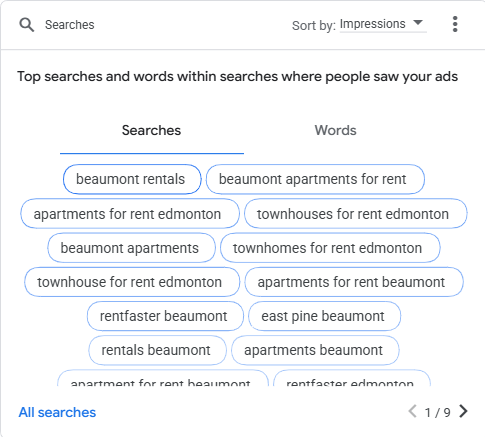
Many renters begin their search with broad queries such as “apartments for rent” or “rentals near me.” They may not initially search specifically for a townhome.
That means a townhome community cannot rely only on exact-match townhome keywords. It needs to compete across broader rental demand while still directing the right prospects toward unit layouts, community information, and viewing paths.
The account also had an attribution limitation.
The client used Calendly for viewing and meeting scheduling, but SwiftPropel did not have access to the Calendly account, CRM, or leasing system. Completed viewings, qualified leads, applications, and leases could not be verified.
For that reason, this case study reports measured renter-interest actions and booking-path activity rather than claiming completed appointments or signed leases.
The Objective
Build a Google Ads system that could:
- Generate rental-interest activity for a townhome community
- Capture broad apartment and rental demand
- Reach renters actively searching for townhomes
- Enter local competitor-comparison searches
- Promote one-bedroom, two-bedroom, and three-bedroom rental options
- Re-engage website visitors who had explored unit layouts
- Drive renters into viewing, phone, virtual-tour, and property-research paths
- Maintain cost-efficient traffic acquisition across Search, Display, remarketing, and call ads
The Strategic Premise
The account was built around one commercial insight:
A townhome community does not need to wait for renters to search specifically for townhomes. It needs to become relevant when renters begin with a broader apartment or rental search.
SwiftPropel used Google Ads to bridge that gap.
The strategy was designed to move renters from broad rental discovery into more specific townhome consideration.
Campaign Architecture
SwiftPropel built and managed a multi-layer account that included:
- Generic apartment and rental-intent Search campaigns
- Townhome-specific Search campaigns
- Local rental-market campaigns
- Competitor-targeting campaigns
- One-bedroom, two-bedroom, and three-bedroom demand segments
- Display prospecting
- Website-visitor remarketing
- Interest-based audience targeting
- Call ads
- Viewing-path and virtual-tour campaign support
Each campaign layer had a distinct role.
| Campaign Layer | Role |
|---|---|
| Search | Capture active rental and townhome demand |
| Townhome campaigns | Position townhomes as an alternative to apartment rentals |
| Competitor campaigns | Reach renters comparing nearby rental options |
| Display | Build awareness among renters earlier in the search cycle |
| Remarketing | Re-engage visitors who had reviewed units or property content |
| Call ads | Create a direct phone-contact path |
| Viewing CTAs | Move interested renters toward the scheduling flow |
Strategy
1. Compete beyond the townhome keyword
The account was not limited to narrow townhome terms.
SwiftPropel targeted broad apartment and rental demand, local rental searches, townhome searches, competitor searches, and location-led demand.
This allowed the property to appear earlier in the renter journey, before a prospect had necessarily decided whether they wanted an apartment, a townhouse, or another rental format.
2. Turn search demand into unit-level research
Once renters reached the website, the campaign needed to guide them beyond the homepage.
Paid traffic was supported by property-research content including:
- Townhome layouts
- Individual suite pages
- Community and amenity content
- Pet-friendly rental information
- Virtual-tour options
- Viewing and contact paths
- Local neighbourhood content
The two principal townhome-layout pages became high-engagement research destinations, showing that visitors were actively evaluating specific rental options rather than only browsing generic property information.
3. Use Display and remarketing to stay in the consideration set
Townhome rentals are not always an instant decision.
Renters often compare multiple buildings, neighbourhoods, floorplans, and price points before taking action.
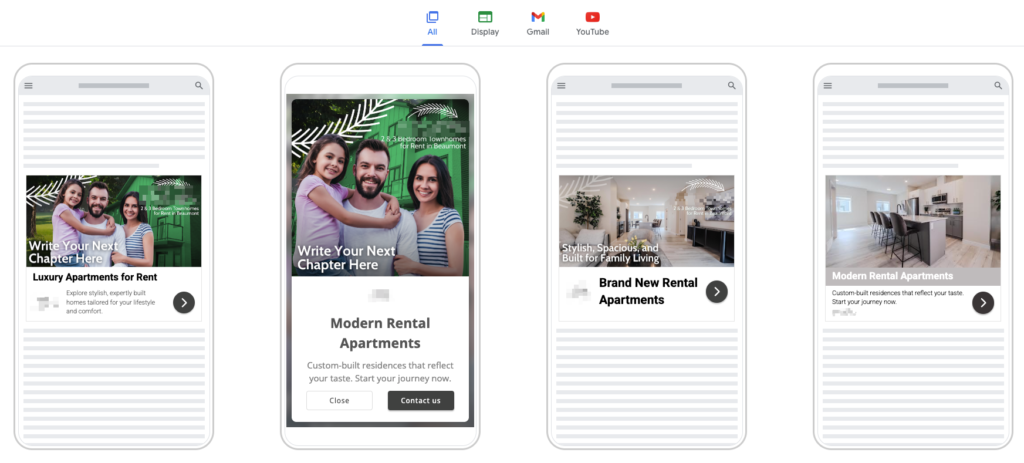
Display and remarketing supported this consideration period by keeping the property visible after initial awareness or website engagement.
The purpose was not to treat Display clicks as completed leads. Its role was to create familiarity, bring visitors back, and support the transition from broad rental interest to townhome consideration.
4. Reach renters at different intent levels
The campaign was structured around distinct renter behaviors:
- Broad rental exploration
- Townhome-specific searches
- Local market searches
- Competitor comparison
- Unit-size research
- Community and amenity evaluation
- Returning visitor behavior
- Viewing and phone-contact intent
This created more control over ad messaging, keyword relevance, landing-page alignment, bid strategy, and budget allocation.
5. Optimize continuously
SwiftPropel managed the account through ongoing optimization work, including:
- Search-term analysis
- Negative keyword refinement
- Keyword expansion
- Competitor monitoring
- Ad-copy refinement
- Bid-strategy review
- Display-placement analysis
- Remarketing audience updates
- Device-performance analysis
- Geographic targeting adjustments
- Dayparting review
- Budget reallocation
- Campaign and ad-group restructuring
The objective was not simply to increase click volume.
It was to increase the property’s relevance across the full rental search market.
Results
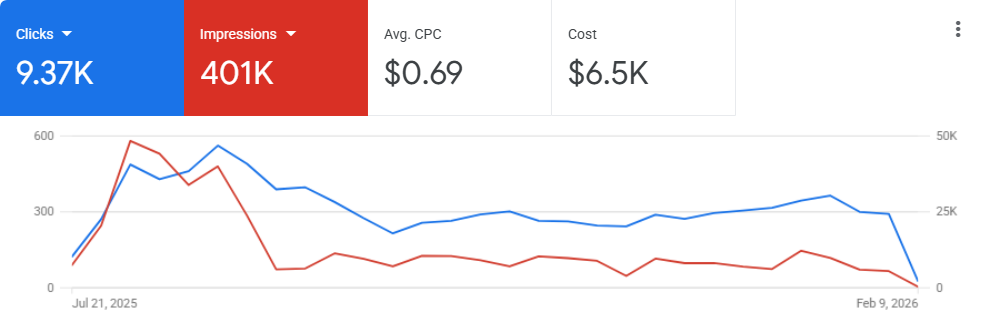
Campaign period: July 22, 2025 to February 10, 2026
| Metric | Result |
|---|---|
| Google Ads spend | CA$6.50K |
| Impressions | 401.1K |
| Clicks | 9.37K |
| Average CPC | CA$0.69 |
| Total tracked Google Ads actions | 2,471 |
| Click Book a Viewing actions | 1,722 |
| View More CTA actions | 421 |
| Phone-number click actions | 79 |
| Contact-page view actions | 42 |
| Virtual Tour click actions | 38 |
| Calls directly from ads | 1 |
Search and Channel Context
The campaign created reach across both high-intent Search and broader discovery channels.
| Channel | Sessions | Engagement Rate | Role |
|---|---|---|---|
| Display | 2,865 | 60.24% | Property awareness and renter consideration |
| Paid Search | 2,813 | 64.74% | Active rental and townhome demand capture |
| Organic Search | 2,224 | 68.79% | Supporting non-paid market discovery |
| Paid Video | 2,049 | 33.28% | Additional awareness support |
Search captured renters who were actively looking for rental options, while Display and remarketing helped maintain visibility during the research and comparison phase.
What the Results Mean
With CA$6.50K in media spend, SwiftPropel generated:
- More than 401,000 impressions
- More than 9,300 clicks
- CA$0.69 average CPC
- 1,722 tracked clicks into the viewing path
- 79 phone-number click actions
- 38 virtual-tour click actions
- Meaningful engagement with townhome layouts, property content, amenities, and local rental information
The account did more than buy generic apartment traffic.
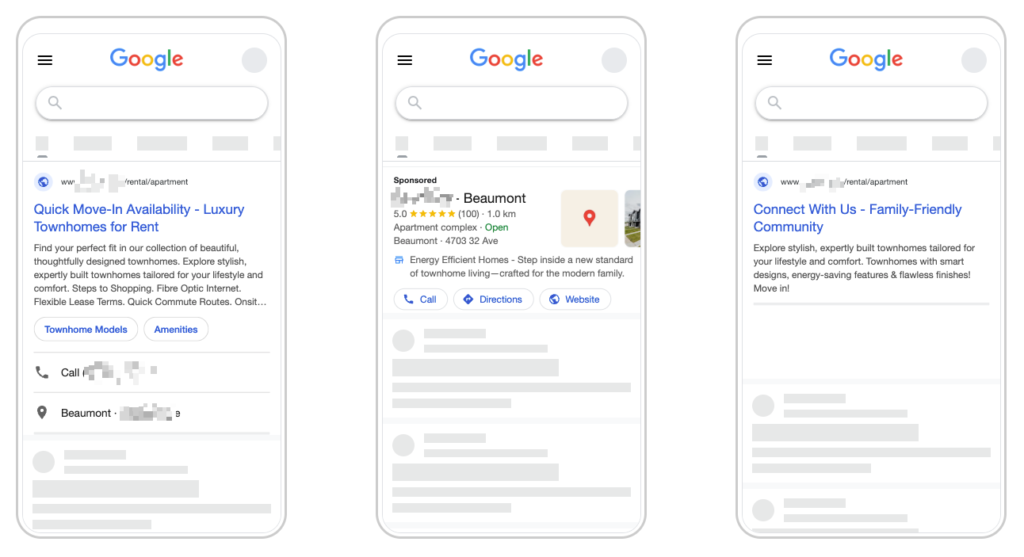
It positioned a townhome product inside a broader rental market and created measurable paths from rental discovery to unit research and viewing intent.
Measurement Note
The campaign recorded 2,471 tracked Google Ads actions during the reporting period.
That number is not presented as 2,471 leads.
It includes a mixture of:
- Book-a-viewing CTA clicks
- View More CTA clicks
- Phone-number clicks
- Contact-page views
- Virtual-tour clicks
- Community-map interactions
- Pet-friendly townhome interactions
- Amenity and property-content actions
- Other engagement activity
Because SwiftPropel did not have access to Calendly, the CRM, or leasing outcomes:
- Book-a-viewing clicks are reported as viewing-path intent, not completed appointments.
- Phone clicks are reported as phone-contact intent, not confirmed calls.
- No claim is made regarding qualified leads, attended viewings, applications, leases, occupancy, or revenue.
Key Lesson
Townhome campaigns should not be built as narrow versions of apartment campaigns.
The real opportunity is to capture renters before they have finalized the type of home they want.
A renter searching for an apartment may ultimately prefer a townhome when the campaign and landing experience clearly communicate:
- More space
- Different unit layouts
- Community features
- Pet-friendly options
- Neighbourhood advantages
- Viewing availability
The strategic advantage came from treating broad apartment demand as an opportunity to introduce a stronger rental alternative.
The campaign was designed to turn generic rental intent into specific townhome consideration.
Engagement Type
White-label Google Ads strategy, account buildout, Search campaigns, Display campaigns, townhome-intent campaigns, competitor targeting, remarketing, call ads, keyword expansion, negative-keyword management, audience optimization, bid-strategy testing, campaign restructuring, budget allocation, and ongoing performance reporting.
Need a Google Ads strategy that helps your property compete beyond generic apartment searches?
SwiftPropel builds paid acquisition systems that turn broad rental demand into property consideration, unit-level research, and measurable contact intent.

Vijay Sood is a seasoned digital marketer with a passion for driving online growth and innovation. With a robust background in developing and executing comprehensive digital strategies, Vijay excels in leveraging SEO, content marketing, and social media to boost brand visibility and engagement. His expertise lies in transforming data-driven insights into actionable marketing campaigns, helping businesses achieve their digital objectives.