
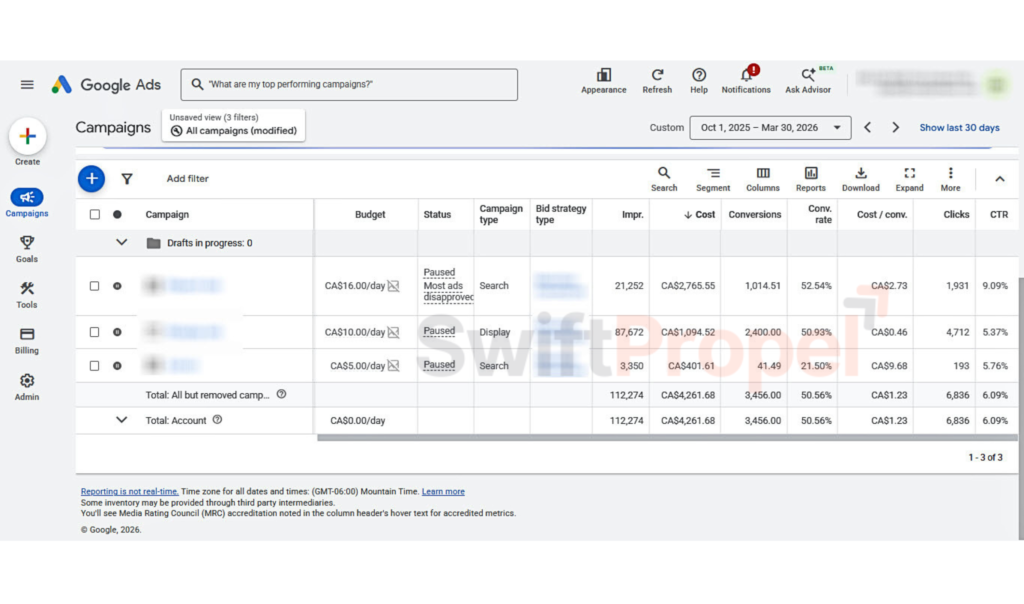
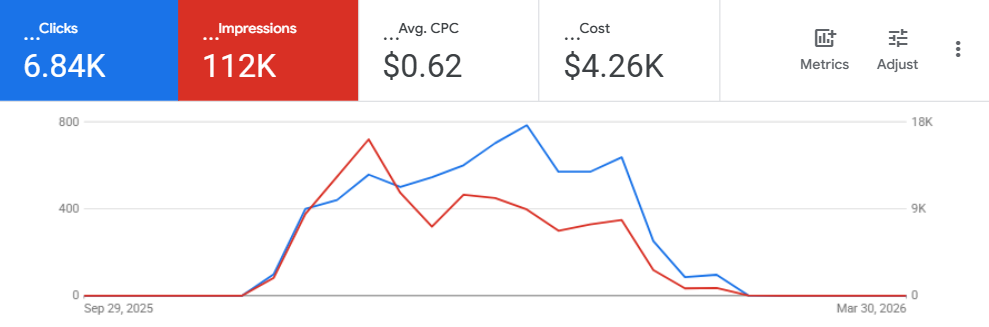
See how SwiftPropel generated 112K impressions, 6.84K clicks, 4.04K tracked renter actions, and 1.8K Register Now clicks through a mobile-first Google Ads strategy for an urban multifamily property.
SwiftPropel was engaged as a white-label Google Ads partner to manage paid acquisition for an urban multifamily rental property.
The business objective was to generate rental enquiries.
This was not simply a “lead generation” campaign. It was a mobile-first rental demand campaign built around the way renters actually behave: they search broadly, compare buildings, review floorplans, inspect suite features, check the gallery, evaluate the neighbourhood, and then decide whether to register, book a tour, call, or submit a form.
SwiftPropel’s role was to build a Google Ads system that moved renters from discovery into measurable next-step intent.
The Challenge
The property was competing in a crowded urban rental market where prospects searched for:
- Apartments for rent Edmonton
- Apartments near me
- Edmonton apartments for rent
- Luxury apartments Edmonton
- Condos for rent Edmonton
- Competitor property names
- One-bedroom rentals
- Two-bedroom rentals
- Rental apartments
A generic rental campaign would not provide enough control.
The campaign needed to handle different renter paths:
- People searching broadly for apartments
- People comparing competitor properties
- People looking for specific unit types
- People evaluating neighbourhood fit
- People engaging with mobile ads
- People returning after an earlier website visit
- People ready to register, call, or book a tour

The operational challenge was also clear: SwiftPropel did not have access to the client’s CRM, leasing records, Calendly data, completed tour data, applications, or signed lease outcomes.
That meant the case study had to stay disciplined and report tracked Google Ads actions, not final leasing results.
The Strategic Premise
The campaign was built around one principle:
Apartment renters do not move from ad click to lease instantly. Paid media has to support the decision path between search, property research, and next-step intent.
The campaign therefore had to do four jobs:
- Capture active apartment search demand.
- Build visibility among renters still comparing options.
- Bring previous visitors back through retargeting.
- Push high-intent users toward registration, contact, phone, and tour actions.
Campaign Architecture
SwiftPropel managed a layered Google Ads structure that included:
- Search campaigns
- Display campaigns
- Retargeting
- Competitor targeting
- Interest-based audiences
- Neighbourhood-focused targeting
- One-bedroom and two-bedroom coverage
- Call ads
- CTA tracking
- Floorplan and suite-feature engagement tracking
- Ongoing search-term and negative-keyword refinement
Each campaign layer had a specific role.
| Campaign Layer | Role |
|---|---|
| Search | Capture renters actively searching for apartment options |
| Display | Build visibility and scale across the rental market |
| Retargeting | Re-engage renters who had already visited the website |
| Competitor targeting | Reach renters comparing nearby or alternative properties |
| Neighbourhood targeting | Capture location-sensitive rental demand |
| Unit-type targeting | Support one-bedroom and two-bedroom search intent |
| Call ads | Give renters a direct phone-response path |
| Register Now CTA | Move interested renters into the primary next-step path |
Strategy
1. Build the campaign around renter intent, not generic traffic
The account was not structured as one broad “apartments for rent” campaign.
SwiftPropel separated renter intent into different campaign and ad group layers, including rental search demand, competitor comparison, neighbourhood interest, retargeting, and unit-type demand.
That structure gave the account more control over relevance, budget allocation, and conversion interpretation.
2. Use Search for direct rental demand
Search campaigns captured people actively looking for rental options.
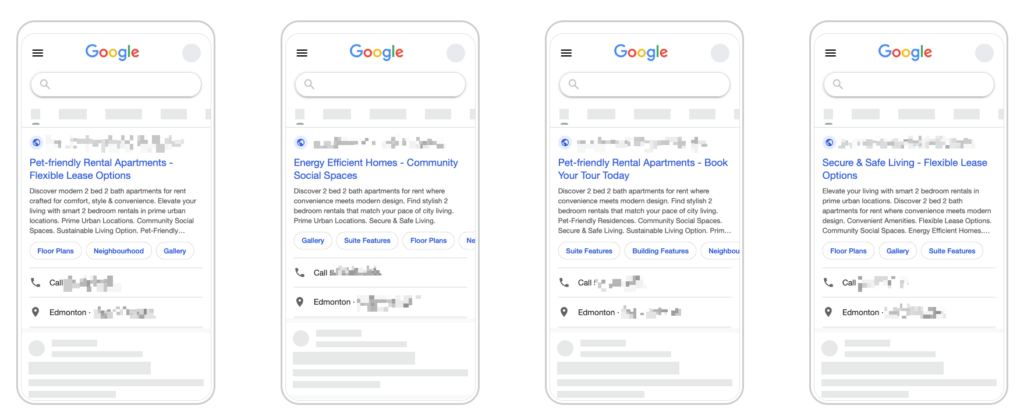
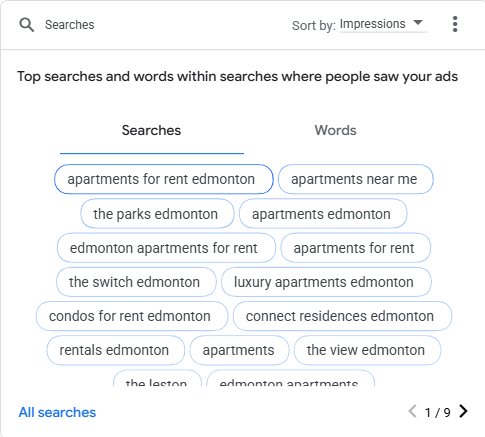
Top search themes included apartment searches, Edmonton rental searches, competitor-related searches, and unit-type searches.
The strongest keyword signals included:
- Rental apartments Edmonton
- Rental apartments
- Rental apartment
- Apartments for rent Edmonton
- One-bedroom rentals
Search was the intent-capture layer.
Its role was to reach people already looking for a place to rent.
3. Use Display for mobile-first visibility and remarketing
The report shows that mobile was the dominant consumption environment.
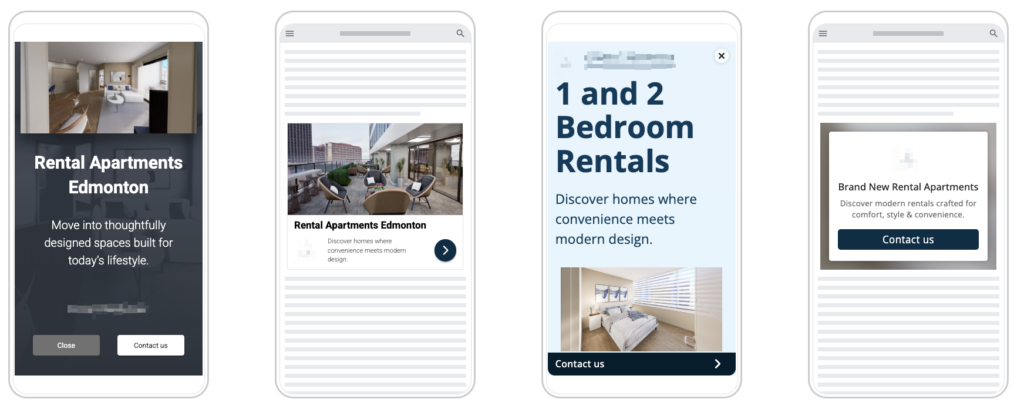
Mobile accounted for most reach and most engagement, which makes the creative and landing experience important.
Display helped the property stay visible while renters were still comparing options. It also supported retargeting, where users who had already visited the website could be brought back into the decision path.
This mattered because apartment decisions are rarely made after one search.
Renters often return multiple times before taking action.
4. Route renters into research pages before asking for action
The campaign supported a website journey where renters reviewed:
- Homepage
- Floorplans
- Suite features
- Building features
- Gallery
- Contact page
- Neighbourhood page
- Booking form
- Thank-you page
These pages were not passive content.
They were part of the leasing decision journey.
A renter who reviews floorplans, suite features, gallery, building features, and contact pages is showing deeper property consideration than a user who only lands on the homepage.
5. Track direct intent separately from research intent
The campaign measured both direct-response actions and consideration actions.
Direct-intent actions included:
- Register Now clicks
- Book a Tour clicks
- Phone-number clicks
- Submit Lead Form actions
Research-intent actions included:
- Floorplan clicks
- Suite Feature clicks
- Gallery page views
- Contact page views
- Building Feature clicks
- Neighbourhood page views
- PDF downloads
- Local actions
- Website visits
- Directions
- Store visits
This distinction protects the credibility of the case study.
A Register Now click is not the same as a signed lease. A floorplan click is not a lead. A phone-number click is not a completed call.
The campaign still produced meaningful leasing-intent signals, but they must be labelled correctly.
Results
Reporting window: October 1, 2025 to March 31, 2026
| Metric | Result |
|---|---|
| Google Ads spend | CA$4.26K |
| Impressions | 112.27K |
| Clicks | 6.84K |
| Click-through rate | 6.09% |
| Average CPC | CA$0.62 |
| Total all-conversion actions | 4.04K |
| Cost per all-conversion action | CA$1.06 |
| Selected website conversion actions | 3,456 |
| Sessions | 8,045 |
| Views | 18,918 |
| New users | 5,678 |
| Engaged sessions | 4,993 |
| Website engagement rate | 62.06% |
Direct-Intent Actions
| Action | Result |
|---|---|
| Click_Register Now | 1.8K |
| Click_BOOK A TOUR | 28 |
| Click_phone number | 28 |
| Submit lead form | 21 |
The strongest direct-response signal was the Register Now CTA.
That action represented the main next-step path during the campaign and showed that paid traffic was moving beyond passive browsing into rental-intent behaviour.
Research and Consideration Actions
| Action | Result |
|---|---|
| PV_Contact Us | 352 |
| Click_Floor Plans | 346 |
| Local actions – Other engagements | 309 |
| PV_Gallery | 174 |
| Click_Download PDF | 144 |
| Click_Suite Features | 141 |
| Local actions – Website visits | 136 |
| PV_Neighbourhood | 106 |
| Click_Building Features | 89 |
| Local actions – Directions | 78 |
| Click_Connect Tower | 68 |
| Click_CONNECT | 57 |
| Store visits | 57 |
| Click_GET IN TOUCH | 39 |
| Click_Download Feature Sheet | 31 |
These actions show that the campaign was not only generating clicks. It was moving users into property-research behaviour: floorplans, suite features, gallery, neighbourhood, contact pages, PDFs, directions, and booking-related paths.
Campaign Performance
| Campaign Type | Clicks | Impressions | All Conversion Actions |
|---|---|---|---|
| Display | 4.7K | 87.7K | 2.4K |
| Search | 1.9K | 21.3K | 1.6K |
| Call Ad | 193 | 3.4K | 71.5 |
Display created reach and retargeting scale.
Search captured high-intent rental demand.
Call ads created a direct phone path for renters who preferred immediate contact.
The campaign was strongest because these layers worked together instead of relying on one channel.
Ad Group Performance
| Ad Group | Clicks | Impressions | All Conversion Actions |
|---|---|---|---|
| Interest | 2.4K | 38.4K | 1,232.16 |
| Neighbourhood | 1.4K | 15.2K | 1,199.99 |
| Retargeting | 1.2K | 22.8K | 592.1 |
| Competitors | 1.1K | 26.4K | 575.73 |
| All apartment types | 275 | 3.8K | 181.91 |
| 2 Bed | 189 | 1.5K | 130.11 |
| 1 Bed | 105 | 740 | 54.5 |
| Call Ad group | 193 | 3.4K | 71.49 |
The data confirms the campaign was not dependent on one generic audience.
The strongest performance came from a mix of interest targeting, neighbourhood relevance, retargeting, competitor comparison, and unit-type intent.
Top Search Keyword Signals
| Search Keyword | Clicks | Impressions | All Conversion Actions |
|---|---|---|---|
| Rental apartments Edmonton | 1,243 | 13,263 | 1,103.98 |
| Rental apartments | 275 | 3,794 | 181.91 |
| Rental apartment | 193 | 3,350 | 71.49 |
| Apartments for rent Edmonton | 119 | 1,969 | 96.01 |
| 1 bedroom rentals | 81 | 553 | 41.17 |
This keyword mix shows that the campaign captured both broad rental demand and more specific apartment-search behaviour.
Website Engagement Context
GA4 showed meaningful property-research activity during the same reporting window.
| Page Path | Sessions | Views | Engagement Rate |
|---|---|---|---|
| Homepage | 7,276 | 11,723 | 65.39% |
| Floorplan | 1,448 | 1,716 | 87.09% |
| Suite Features | 842 | 1,166 | 91.45% |
| Gallery | 732 | 836 | 85.93% |
| Building Features | 664 | 774 | 89.16% |
| Contact Us | 633 | 1,074 | 91.79% |
The engagement rates on floorplan, suite features, gallery, building features, and contact pages are important.
They show that users were not only landing on the site. They were reviewing the pages renters typically use before deciding whether to register, book a tour, or contact the leasing team.
Traffic Source Context
| Channel | Sessions | Engagement Rate |
|---|---|---|
| Display | 3,243 | 63.12% |
| Paid Search | 1,845 | 65.69% |
| Organic Search | 1,027 | 68.26% |
| Direct | 1,009 | 42.22% |
| Referral | 848 | 70.64% |
Display and Paid Search were the two largest acquisition channels during the reporting window.
That matches the paid media strategy: Display created scale and repeated exposure, while Paid Search captured active rental intent.
Geographic Context
Canada accounted for the overwhelming majority of website activity during the reporting window.
| Country | Active Users | Engagement Rate | Average Engagement Time |
|---|---|---|---|
| Canada | 5,256 | 63.5% | 1m 01s |
| United States | 178 | 38.25% | 32s |
| India | 56 | 67.53% | 1m 12s |
| Germany | 37 | 32.43% | 5s |
| Netherlands | 36 | 77.78% | 5s |
This supports the campaign’s local relevance: the strongest traffic concentration came from the target rental market.
Mobile-First Behaviour
The campaign was heavily mobile-driven.
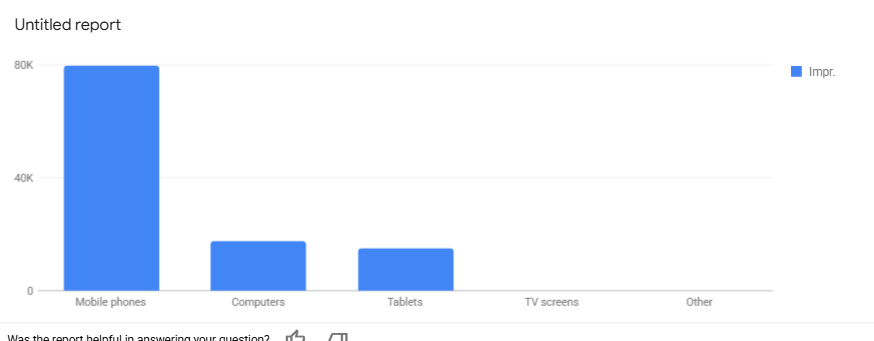
The device report shows mobile generated the majority of both reach and engagement. That matters because apartment discovery increasingly happens on mobile devices, especially during early comparison and retargeting stages.
For this campaign, mobile was not a secondary consideration.
It was the main user environment.
That made the ad message, CTA path, landing-page speed, and mobile page experience commercially important.
What the Results Mean
With CA$4.26K in Google Ads spend, SwiftPropel generated:
- 112.27K impressions
- 6.84K clicks
- 6.09% CTR
- CA$0.62 average CPC
- 4.04K all-conversion actions
- 3,456 selected website conversion actions
- 1.8K Register Now clicks
- 346 Floorplan clicks
- 352 Contact Us page-view actions
- 141 Suite Feature clicks
- 28 Book a Tour clicks
- 28 phone-number clicks
- 21 tracked Submit Lead Form actions
- 8,045 GA4 sessions
- 18,918 GA4 views
- 4,993 engaged sessions
The campaign’s value was not that every tracked action was a lead.
The value was that paid media created a measurable path from apartment search and mobile discovery into deeper property research and registration intent.
Measurement Note
The 4.04K all-conversion total is not reported as 4.04K leads.
It includes primary and secondary conversion actions.
Primary actions included Register Now clicks, Book a Tour clicks, phone-number clicks, and Submit Lead Form actions.
Secondary actions included floorplan clicks, gallery views, suite-feature clicks, contact-page views, PDF downloads, neighbourhood views, local actions, website visits, directions, and other research behaviour.
SwiftPropel did not have access to CRM data, Calendly records, completed tours, final lead quality, applications, signed leases, revenue, or occupancy reporting.
Therefore, this case study does not claim:
- Qualified leads
- Completed tours
- Booked appointments
- Applications
- Signed leases
- Occupancy gains
- Revenue attribution
- Return on ad spend
Key Lesson
For an urban multifamily property, Google Ads should not be judged only by form submissions.
A serious renter may show intent by clicking Register Now, reviewing floorplans, viewing suite features, opening the gallery, checking the contact page, downloading a feature sheet, clicking to call, or returning through retargeting.
The stronger campaign model is:
Mobile discovery → rental search intent → property research → registration intent → contact or tour action
SwiftPropel’s campaign structure supported that full path by combining Search, Display, retargeting, competitor targeting, neighbourhood relevance, unit-type coverage, and mobile-first CTA tracking.
The strategic advantage was not just low CPC.
It was building a paid acquisition system that converted apartment-search demand into measurable renter intent across the pages and actions that matter before enquiry.
Engagement Type
White-label Google Ads management, Search campaigns, Display campaigns, retargeting, competitor targeting, neighbourhood targeting, unit-type campaign support, call ads, Register Now tracking, Book a Tour tracking, phone-click tracking, form-submit tracking, floorplan engagement tracking, suite-feature tracking, PDF-download tracking, search-term analysis, negative-keyword refinement, ad-copy refinement, bid-strategy review, audience segmentation, budget reallocation, mobile-performance review, and performance reporting.
CTA
Need Google Ads that move renters beyond browsing and into measurable property intent?
SwiftPropel builds paid acquisition systems that connect apartment search demand, mobile discovery, retargeting, property research, and registration intent into one structured growth engine.
Recommended Website Title
From Mobile Apartment Search to Registration Intent: How SwiftPropel Built a Google Ads Engine for an Urban Multifamily Property
Recommended Meta Description
See how SwiftPropel generated 112K impressions, 6.84K clicks, 4.04K tracked renter actions, and 1.8K Register Now clicks through a mobile-first Google Ads strategy for an urban multifamily property.

Vijay Sood is a seasoned digital marketer with a passion for driving online growth and innovation. With a robust background in developing and executing comprehensive digital strategies, Vijay excels in leveraging SEO, content marketing, and social media to boost brand visibility and engagement. His expertise lies in transforming data-driven insights into actionable marketing campaigns, helping businesses achieve their digital objectives.