
In the ever-evolving landscape of digital advertising, maximizing Return on Ad Spend (ROAS) remains the paramount goal for marketers. A significant move towards using automation and machine learning to achieve conversion goals across Google’s entire inventory is Google Performance Max (PMax) campaigns. This means that the campaign can run not only on Search ads, the Display Network, YouTube ads, Gmail, Discover, and Maps, but also anywhere on Google. With such a massive reach and efficiency, the success of PMax is entirely up to the algorithm, but actually, it is still the advertiser who has to provide the strategic input and organize the account.
In this article, we will explore key roles of Asset Groups in Performance Max, guiding audience targeting and ultimately maximizing campaign results through the proper use of ad structure, text asset planning, and PMax optimization strategies.
What Are Asset Groups in Performance Max Campaigns?
Asset Groups in PMax campaigns are the deliberative associative links that bring together the creative components (assets) and audience signals under a specific theme, product category, or conversion goal. These groups provide a set of ads (search, display, video, etc.) united by a familiar storyline, thus becoming individually targetable segments of a wide campaign. When you upload different kinds of content, e.g., a video of a product is shown as well as a picture, both pieces of content are used along with text and are put in an asset group.
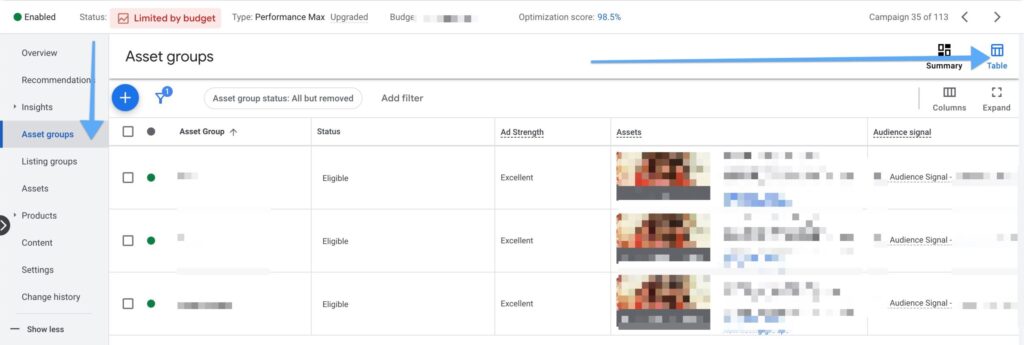
Thus, the performance of Max asset groups offers the algorithm a complete set of text, pictures, and video to use in whichever way it will perform the best in different ad placements. Google then takes this pmax asset setup and, without any human intervention, it creates different asset combinations in the best-performing version for every placement automatically.
Once you have asset groups set up reasonably, you enable the algorithm to figure out who your target group is and what products and product categories you deal in, as well as the manner of creating and showing the ads based on quality text assets, URLs, final URLs, and product listings from the Merchant Center.
Key Roles of Asset Groups in Performance Max Campaigns
Knowing and using asset groups in a tactical manner is the main factor that allows one to make full use of PMax’s power. Here are the seven key roles that PMax Asset Groups play in maximizing campaign performance:
1. Facilitating Thematic and Product-Specific Targeting
With Asset Groups, you can accumulate the components that share a particular theme or are related to specified products or product categories. By differentiating the asset group distinctly for the different products (e.g., “Summer Shoes” vs. “Winter Boots” for a footwear retailer), you provide PMax with the necessary information.
With this, PMax will not create a generic advertisement for all but will instead choose to deliver personalized ads for different audience intents. As a result, it has a direct impact on Quality Score, ad engagement, and the clarity of your category-level listing group in e-commerce campaigns.
2. Optimizing Creative Relevance and Ad Variety
A sound Asset Group will contain the various types of headlines, long headlines, descriptions, square images, horizontal images, and even videos. The primary purpose of the automation is to execute all possible combinations and identify the winning ones for each placement, and for this reason, all of the supplied elements are used.
The more different elements you provide, the more differently PMax will be able to operate the creative testing process and come out with more diverse ad experiences across Search, Display, YouTube, and Discover. What this means is that the system gets to optimize performance across all types of inventory while at the same time the creative stays consistent with the brand guidelines set by you.
3. Signaling Audience Intent and Context
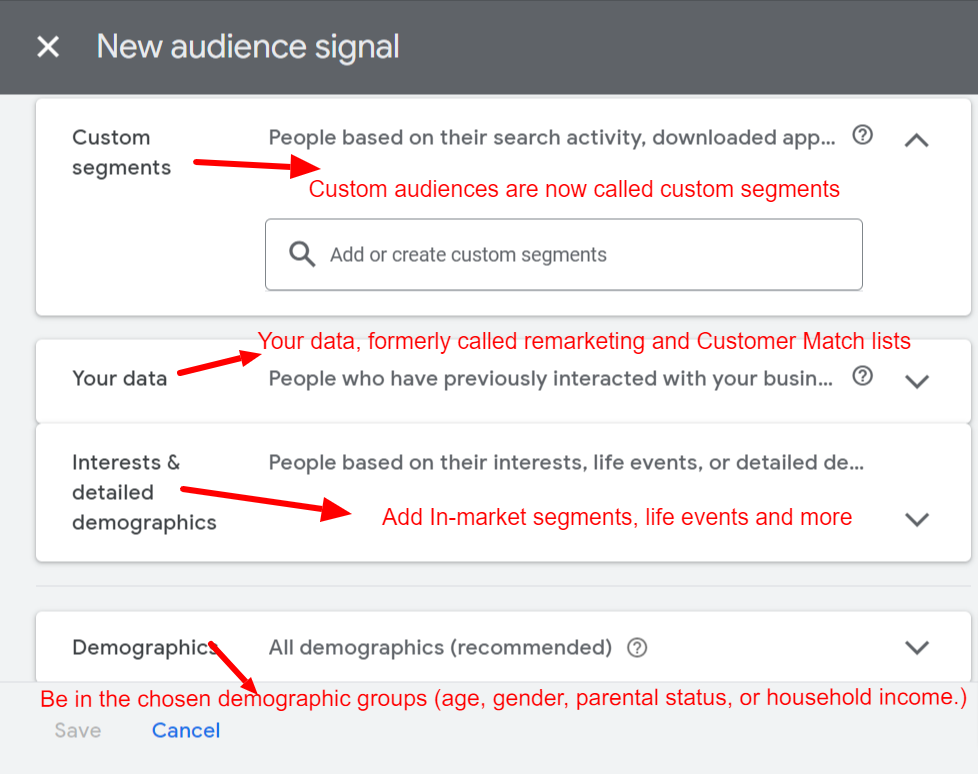
Even though PMax campaigns are automated, the audience signal you attach to each asset group plays a vital role. These signals, like Custom Segments, data segments, interest segments, and remarketing lists, tell Google who is most likely to convert.
For instance, an audience signal on ‘users searching vegan recipes’ when Asset Group is advertising a vegan cookbook will do wonders in helping the system find the most suitable target audience. This leads to a higher level of efficiency, less money wasted, and your assets becoming more in line with the correct audience journeys. This also allows you to build custom audience lists and have more control over how automation works without completely stopping it.
4. Enabling Performance Reporting and Diagnostics
PMax has fewer reporting functions than those available in traditional searches, but, as Asset Groups give visibility at the ad group level, they can be of great help. The following metrics can be monitored by you:
- Conversions
- Conversion value
- Asset performance (Low, Good, Best)
With this information, marketers can improve keyword themes, substitute text assets that do not perform well, check the display path for relevance, and keep the messaging consistent. This campaign scaling is totally dependent on data-driven optimization.
5. Enhancing Budget Allocation Efficiency
Google decides on the budget distribution according to the differently segmented products that you have put in various Asset Groups. The software is designed to rank the ones that bring out better results from a quality, relevance, and likelihood of conversion point of view on metrics. And hence promote those to the top. The system, which is based on algorithms, naturally promotes high-quality units of a product with good metrics, relevance, and probability of conversion to the top of the chosen units for such things as clicks and impressions.
As far as the electronic commerce companies are concerned, it is a good idea to form a product listing group through the Merchant Center and then categorize the different product groups, house or showroom categories to see where the budget would really flow, for example, toward profitable categories and thus improve the e-Commerce businesses’ most crucial metric-ROAS further amplified through the entire google ads ecosystem.
6. Providing Guardrails for Creative Control and Brand Safety
While PMax automates ad generation, you still control the inputs like text, assets, images, videos, and logos. These serve as creative boundaries ensuring consistency, brand safety, and relevance.
These act as creative limits, thus ensuring not only the consistency but also brand safety and relevance. This is necessary for those brands that have stringent regulations in terms of tone, visuals, compliance, or sensitive kinds of messaging.
7. Facilitating Continuous A/B Testing and Iteration
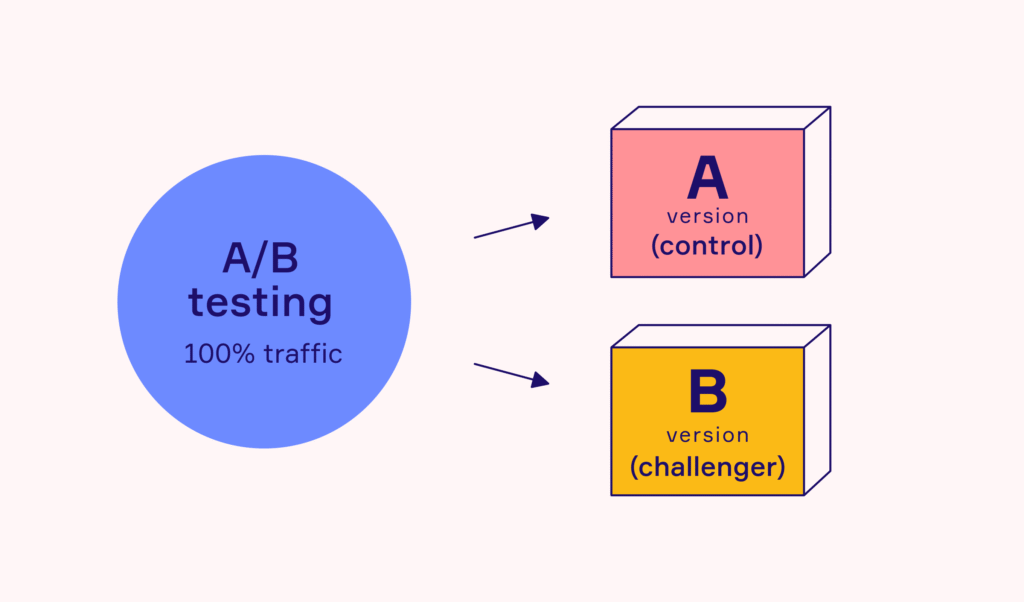
Every Asset Group is similar to a creative testing lab that works non-stop. Google always tests each element—be it headline, image, or text—against different placements and target segments for each group. The only thing you have to do is look at the asset performance labels and change the low-performing ones. This feature makes PMax one of the most powerful automated creative testing tools.
You may try out:
- New descriptions
- Different format variations
- Fresh visuals
- New audience signal segments
- Alternative listing and URLs
This uninterrupted learning loop is the main factor behind PMax’s long-term success.
Conclusion
Asset Groups constitute the tactical base for any effective Performance Max campaign. They are the link that connects your marketing intention (segmentation, message, target audience focus) with Google’s sophisticated automation. By preparing top-notch, thematically pertinent Asset Groups loaded with various creative, properly structured headlines, SEO-friendly descriptions, and accurate audience signals, you make sure that the algorithm always operates with the best possible elements.
This is what leads to maximum ad relevance, better budget use, higher conversion rates, and higher-level performance across the Google network, including Google Search, YouTube, Display, and Shopping.

Vijay Sood is a seasoned digital marketer with a passion for driving online growth and innovation. With a robust background in developing and executing comprehensive digital strategies, Vijay excels in leveraging SEO, content marketing, and social media to boost brand visibility and engagement. His expertise lies in transforming data-driven insights into actionable marketing campaigns, helping businesses achieve their digital objectives.