Landing pages are where marketing gets measurable. Many marketers never know the impact their marketing has on their business because a poorly designed landing page converts less than 1% into leads. A well-designed landing page will convert 10% into leads. The difference is not often significantly better headlines or superior copy, it’s about removing the friction points that hinder conversion in the first place.
AI-driven heatmaps reveal these friction points instantly. Keep reading to learn how AI-driven heatmaps and predictive analytics can transform your landing page assets into high-converting lead generation engines.
Why Landing Pages Are Perfect for Heatmap Optimization
A landing page is quite distinct in terms of content from traditional web sites and landing pages on a regular domain. Their purpose is to be constructed in order to prompt a particular conversion activity. A landing page is a great choice for heatmap analysis because:
- One conversion objective: Measuring success isn’t that difficult (email sign-up, demo request, purchase).
- Defined user flow: Users will generally scroll from top to bottom with little navigation.
- A lot of people clicking the same pages over and over again: Paid ads drive traffic to the same pages over and over again.
- Most landing page traffic is from mobile ads: Traffic from mobile ads is the primary source of traffic to the landing page.
- Measurable ROI: Every conversion worth a dollar value.
- Instant optimized impact: Micro friction optimizations deliver instant lift.
In most cases of landing page optimization, it’s still simple common sense: “Let’s make the headline bigger. Change the button’s color to red.” Structured AI optimization and heatmaps take out the guesswork, forever redefining the way an ambitious marketer does conversion optimization.
What Heatmaps Reveal About Landing Page Behavior
A thorough behavioral audit of your landing page design uncovers three behavior patterns that users expect:
Pattern 1: Scroll Behavior (Where Users Stop)

Scroll heatmaps show how much they scroll before leaving your page. What to look for in an effective landing page generator:
- Abrupt drop in engagement at specific sections; scroll cliff
- Users exit prior to reaching critical content
- Form abandonment point
- Different scroll distances by different device
This is an example of a B2B Saas landing page that had 40% of visitors who scrolled past the headline and 15% who made it down to the pricing section. This AI insights assessment showed that the form placement was too far down on the page.
Pattern 2: Click Patterns (Where Users Engage)

Click heat maps reveal elements that are focused on and interacted with. What to look for:
- The number of users that click your main call to action.
- Competing clicks—occurred when users appeared to click on the navigation links or other secondary elements as opposed to the primary CTA.
- Hovers over non-clickable items—Users hovering over items that are not clickable
- Dead zones that are tracked by AI — Areas of the page that no one interacts with.
- Image vs. text clicks — Whether or not users are clicking on text or pictures
Example: If 47 people clicked on the company’s logo landing page among 1000 users viewing the landing page and the main Call To Action (CTA) received 240 clicks, the company will decide that it needs to improve the navigation to get the traffic to the main CTA. The navigation link on the logo was found to have a negative effect on CTA clicks—removing it increased the number of clicks by 18%.
Pattern 3: Engagement Pattern

Displays the user’s pattern of interaction. Heatmaps are a visual way to present where users linger, hesitate, experience confusion and slow down. Points to observe:
- Hover activity – Long hovers mean those users who are reading or taking decision
- Rage clicks — clicks made on the same element over and over again (frustration)
- Field hesitation — Users clicking on a field but not typing anything.
- Mobile click precision — Users that are unable to find small buttons
A landing page form experienced rage clicks, or 5-6 clicks in a short period of time, on the email field. The investigation showed that the field label “Email Address” was not clear as compared to another competing landing page template design with the field “Your Email for Special Offers.”
How AI Works in Optimizing Landing Pages
The future of AI in marketing is one where it is actively contributing to the creation, optimization, and scaling of custom landing pages. Let’s examine the effects of AI as you adopt the appropriate AI system to run your landing page production.
Predictive Analytics and User Behavior Insights

Advanced AI can scan large amounts of data to find trends that a human marketer would never have noticed. This data is analyzed by AI and used to identify trends of user page engagement and which pages people click on, how long they scroll down, whether they bounce or not and how various actions contribute to a successful conversion rate improvement. Analyzing this data, AI can predict what visitors are more likely to convert, what content elements they’re going to interact with and where they are likely to drop off.
By having this foresight you can:
- Tackle potential friction points (such as long forms, slow pages and elements) proactively.
- Be sure to focus on high intent segments to re-target or put them on a custom page.
- Make the landing pages more effective based on the results of the prediction performance from the AI landing page generator.
Picture a B2B business running a campaign to generate demo requests for its project management product. The landing page has a headline, a benefits area, the customer logos, walkthrough video of the product, and a lead capture at the bottom.
The AI shows there is a very high bounce rate for visitors from the mobile ads. It mentions two issues: the time it takes for people to scroll down to the form, as well as the time people have to wait for the video above the fold inside the form.
The team uses this data to just move the lead capture form on top of the video on mobile devices, remove the embed video that is slowing down the mobile, and put sticky CTA on the video that trigger when user scrolls it back up.
Automated Content and Layout Adjustments

An intelligent AI website constructor is that the visitors of the website finds an easier navigation, even while they are on mobile, this is possible by thumb friendly navigation.
This is achieved through the software’s usage of dynamic optimization on your landing pages:
- Refining and evaluating various configurations of the page elements (headline, hero graphic, placement of call to action, etc.) over thousands of user sessions.
- A/B testing pages variants according to the better conversion and redirecting visitors to the best variants automatically.
- Developing multiple layouts to accommodate different screens, exploring engagement shape and develop user habit.
The end result? Your home page design will evolve over time to what works best, without having to perform new tests on it daily.
AI might organize the page differently if speed or solo dev use cases had been clicked on by the exact same user, for example presenting load time metrics or priority to-do lists or solo sprint boards at the top.
AI-Generated Headlines, CTAs, and Images
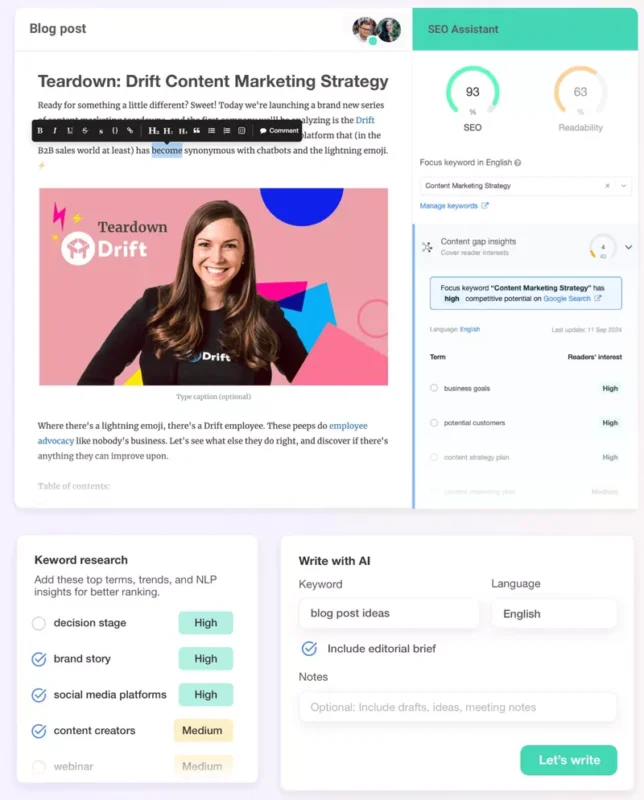
Generative optimization is one of the most effective capacities of AI, as it generates content parts optimized for performance.
Today’s AI tools can provide tools that can:
- Create attention grabber headlines and copy that is designed to convert that attention.
- Propose or generate pictures that go with the page contents and audience’s tastes.
- Create customized call-to-actions depending on the actions users have taken or are taking within their journey using the landing page builder.
This will save time and guarantee that information backs every component of your landing page, not the feeling you have. Also, because AI is considering what’s working in real time, it continually optimizes the creativity for increased clicks and conversions.
Common Landing Page Problems Heatmaps Reveal
Every landing page has hidden friction points that quietly reduce conversions, and AI-powered heatmaps make these issues impossible to ignore. Here are some of the most common issues found on landing pages using heat maps, and how to analyze the data to improve your visitor’s experience and generate more leads.
Problem 1: Invisible CTA
When the focus of the primary CTA is hard to see, visitors tend to overlook it, or find it too hard to click, resulting in lost conversions. Check heatmaps showing the low click rate on the CTA, overwhelming navigation activity and premature scroll drop-off. Increasing the visibility, positioning, size and copy of the button allows visitors to easily take the desired action.
Problem 2: Scroll Cliff (Form Placed Too Low)
Putting the conversion form too far down the page, as evidenced by the sharp scroll drop-offs and low form views in heatmaps will cause a significant drop-off in form submissions as visitors bounce before even seeing it. Taking up the top of the page and removing the fluff can boost conversions.
Problem 3: Form Field Drop-Off
users start to complete a form and then abort it when they find an unintuitive or intrusive input field. Heatmaps can be used to pinpoint usability friction points with rage clicks, hovering and abrupt exits on specific fields. Improving completion rate by providing more guidance, making optional fields clear and reducing the length of the form:
Problem 4: Mobile Conversion Collapse
Even if you have a high-performing desktop landing page, you could be missing out on huge numbers of mobile conversions because of a non-optimized experience. Heatmaps reveal that this landing page has too much scrolling, buttons that are hard to click, and form abandonment. Improving the mobile design, making click targets larger and nearer to the beginning of the page, will significantly increase your mobile conversions.
Conclusion
Although it takes a number of factors into consideration, conversion cannot just come through traffic. The key to growth in the digital space lies in your capacity to nurture and convert these visitors into customers.
By applying conversion optimization intelligently, your business can enhance user experience, generate revenue, and deliver sustainable results. Through expert and AI-powered applications you’ll discover sustainable and scalable conversion growth.

Vijay Sood is a seasoned digital marketer with a passion for driving online growth and innovation. With a robust background in developing and executing comprehensive digital strategies, Vijay excels in leveraging SEO, content marketing, and social media to boost brand visibility and engagement. His expertise lies in transforming data-driven insights into actionable marketing campaigns, helping businesses achieve their digital objectives.