Mining and qualifying leads has always been fundamental to growing a business, but the methods are evolving rapidly. The pace of traditional lead-generating methods cannot match that of customers nowadays.
Now a lead generation chatbot is bridging this gap. These intelligent AI tools are revolutionising the sales funnel by interacting with your website visitors in real-time, qualifying relevant leads by asking good questions and capturing lead data to return to your sales team. Rather than waiting hours or days for email responses, new leads get the answers they need and your business secures which-to the best quality leads-24/7.
In this guide, we are going to discover what lead-generation chatbots are, why they are important and how to revolutionize your sales funnel.
What is a Lead-Generation Chatbot?
A lead-generation chatbot is not simply a cute pop-up on your website. It is a sophisticated digital concierge that is designed to turn visitors into leads and it’s the perfect tool to automate lead generation. Instead of waiting for a user to complete a typical static form-a classic lead-qualifying tool, chatbots take the lead by harnessing the persuasive power of conversation, with relevant questions posed in order to help what could be a cold lead develop into a warm sale-worthy one all while improving the customer experience.
There are a few types of chatbots in this area, each with its own strengths to suit specific business needs:
- The rule based bots follow a predefined conversation and aim to gain contact details or help answer FAQs by relying only predefined rules.
- AI uses natural language processing and machine learning algorithms in order to respond to users depend on their inputs, which enable chatbots to be more natural, conversational and customized.
- Hybrid chatbots combine automated responses with live chat handoff to make sure prospects can access help from a human.
This is where true power is possible: automation and customization. Chatbots deliver a seamless two-way interaction that seems personal but is executed unobtrusively in the back end. Imagine a potential guest is browsing your website looking for prices. They have the ability to skip all the different pages to find them and instead are welcomed by your AI chatbot who not only responds to their initial query, but exchanges valuable contact details and then asks if they’d like to see a demo or set an appointment. Your prospect feels invested and appreciated and your sales team receives a ready made warm lead every time!
This kind of interaction does two things: It offers prospects the instantaneous, tailored experience they want in a shorter time frame, which increases satisfaction by cutting wait time. Also, a business who does it gets information they need to qualify their leads-and thus improves lead closing ratios-by using it as a tool for lead management.
How AI Lead Qualification Works
Today’s lead qualification process is intelligence-driven. AI chatbots end-to-end qualify lead for automation by using a glue of conversation flows, intelligent question, scoring rules and routing engine. They listen to a visitor’s speech, follow up with a strategic question and determine how to forward the lead to sales or delay to self-serve.
By implementing AI-powered lead qualification, companies can streamline their operations and score leads based on intent. When using AI on a platform like AI Chat for Business, the AI lead qualification process usually looks like this:
1. Detect Intent and Greet the Visitor

The bot recognizes if a visitor is just looking around, price shopping, or inquiries support questions. It is able to utilize page context (like your pricing or demo page) combined with behavior triggers (exit intent/time on page). Find out more about those triggers in our feature overview.
2. Answer First, Then Qualify

Rather than beginning by presenting the form, your bot goes directly to answering questions by tapping into your knowledge base and semantic search. After briefly assisting, it goes into light qualification, like: Would you consider your question as you assessing tools for your team, or just looking around right now?
3. Ask Structured Qualification Questions

Next, the bot asks a series of short, qualifying questions about the size, budget, timeline, type of service, and urgency of the potential projects. The answers to these questions are fed into a series of scripted scoring rules (hidden from the user) that assign a numeric score for each response. The scoring criteria record how ready the contact is to buy.
4. Use Sentiment and Engagement Signals

AI Chat for business has internal sentiment analysis, so it can see if someone is eager, uncertain or angry. A matter of high engagement, good sentiment, and powerful answers is normally a good lead with a very good chance of conversion.
5. Score and Segment the Lead
Given the rules that you create, for example “businesses over 50 employees with a 3-month time frame”, the bot will then identify the conversation as being a qualified lead, a market qualified lead, or not a fit. This is the same logic we outlined in our artificial intelligence chat for business piece as a way to gauge a prospect’s likelihood to convert.
6. Route to the Right Place
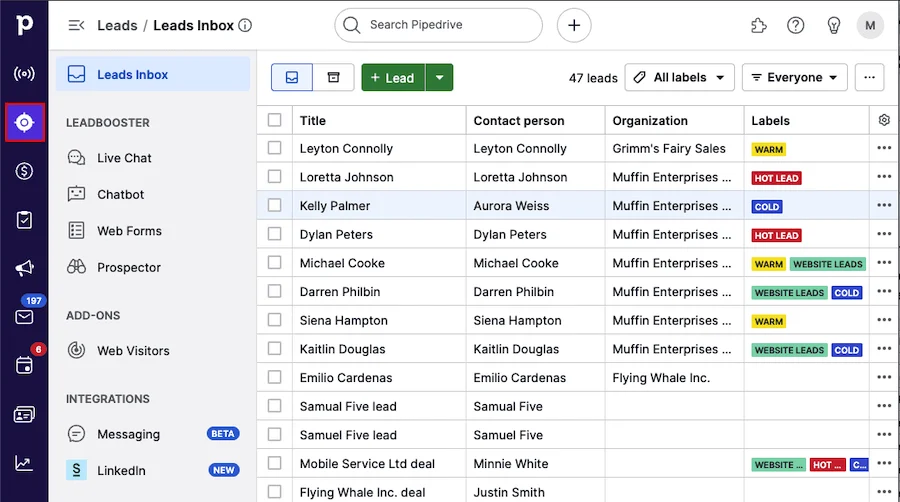
Qualified leads should be pushed to the sales inbox, synced to your CRM (such as HubSpot), or booked directly into a calendar so that high-intent conversations are delivered in real-time to the right account executive. Not-quite-ready for conversion? Nurture them with educational content or captured through email.
This flows seamlessly within your entire website widget and messaging channels. You manage the questions, scoring thresholds and routing rules and the AI manages the entire conversation and context, enabling sales teams to focus all their attention on closing.
Best Practices
What works the best is an easy going, casual tone, simple short questions, straightforward routing rules. Remember, the bot should resemble a friendly assistant, not a registration form.
Here are practical best practices that work well for founders, marketers, and sales teams looking to prioritize and manage leads effectively in B2B marketing:
- Ask the bot instead of asking the bot: Allow the bot to solve a real problem and address a real question before sending instruction about the details you require. For instance, give price band estimates or product suggestions, then add, “I can provide you a more personalized suggestion, do you mind if I ask you a few quick questions?” This how it works for the first time, with the use of conversational context, semantic knowledge search.
- Choose answers fast to pick: If your question has options like amount of budget or days put in buttons. Make it quick than write them. Also make things simplified. Textbox for say, ‘what are you trying to do?’.
- Match your lead scoring to your actual sales process: Collaborate with your sales team to come up with your definition of a qualified lead-e.g., “US-based, 20+ employees, 3-month timeline, high urgency”. Tag and route the leads using your rules in your AI Chat for Business bot.
- Make multiple channels but stay consistent with the logic: Your website, Instagram, WhatsApp should have the same qualification logic; the AI Chat for Business unified inbox displays individual context among channels.
- Review analytics and optimize: Identify questions that are linked to closed deals. Discard questions that don’t contribute to qualifying prospects. Use analytics included with each plan on our pricing page to monitor your chatbot performance and adjust your configuration over time.
The right chatbot platform can be a key factor in your long-term success and can significantly boost conversion rates while streamlining your entire lead management system. However, chatbot performance also depends on the surrounding acquisition strategy, including traffic generation, landing-page experience, and conversion tracking. Businesses that need help connecting these elements can work with SwiftPropel.
Common Mistakes
The leading mistakes with AI lead qualification are design misses such as repurposing chatbots as static forms as opposed to proactively qualifying leads, and overreach-pressuring prospects for contact details. Stay away from these pitfalls to safeguard your conversion rates and provide a positive lead qualification experience.
- Requesting email or phone too soon: If the first message is “give me your email” more than half of visitors will leave. First enable the AI to be helpful. AI Chat for Business is scripted to give information, identify interaction, then ask for contact when the visitor is interested.
- Asking long, complex questions: Questions like ‘Can you go into detail about your full tech stack and your evaluation criteria,’ creates friction. Take the question and break it into small, conversational prompts. For instance, ‘How large is your team today,’ and then, ‘When do you expect to have a headcount?’.
- Not scaling conversations (support vs sales): If every chat initiates a qualification journey, support customers will find it annoying. Find a way to differentiate page context and intent detection so that qualification only happens when users have buy signals, like asking about pricing or features. This delicate automation/human balance will be a key factor to user satisfaction.
- No clear routing rules: If your bot tags leads but doesn’t route them out anywhere, your team will still lose opportunities. Define clear rules so a hot prospect gets routed flawlessly (“If score high send to sales in Slack and assign to rep”). AI Chat for Business has this capability enabling you to automatically assign and handle a new lead.
- Disregarding analytics and feedback: If you ignore calling up conversation logs and analyzing metrics, you will not know at what point prospects fall through the cracks. Leverage your dashboard to identify where prospects stop responding and modify your questions or pace in order to qualify leads more efficiently. More tips can be found in our resource on improving conversations utilizing AI chat.
Conclusion
Implementing a chatbot lead qualification can be the game changer for your business qualification and sales promotion. Seeing concrete results in efficiency and conversions, a chatbot minimizes your sales team interaction with already-qualified leads by text by automating those highly qualify interactions. With conversational qualification, you can better understand your customer needs and pain points than with a generic lead form.
Never expect your Success chatbot qualification to be entirely accurate from day 1. Start off with a simple qualification flow leveraging just your main criteria-budget, timeline and decision maker. Measure results, learn how your prospects utilize your chatbots and refine so that your qualification process constantly improves.

Vijay Sood is a seasoned digital marketer with a passion for driving online growth and innovation. With a robust background in developing and executing comprehensive digital strategies, Vijay excels in leveraging SEO, content marketing, and social media to boost brand visibility and engagement. His expertise lies in transforming data-driven insights into actionable marketing campaigns, helping businesses achieve their digital objectives.