
SwiftPropel was brought in as a white-label Google Ads partner to build and manage paid demand generation for a downtown multifamily rental property in Calgary.
The objective was simple: generate rental enquiries.
The execution was not.
The account had to be built from scratch, campaign activity had to respond to changing inventory, and the client’s contact form was embedded through a third-party GoHighLevel system rather than the website’s native form infrastructure.
That meant the campaign needed to be structured around renter intent, landing-page relevance, and measurable enquiry actions—not inflated conversion totals.
The Challenge
The property needed consistent rental demand across different unit types and renter profiles.
The initial paid-media setup could not rely on a single generic “apartments for rent” campaign. Renters searching for a one-bedroom, comparing nearby buildings, looking for a specific neighbourhood, or returning after viewing floorplans have different levels of intent.
There was also a conversion-tracking constraint.

The client used an embedded GoHighLevel form, and SwiftPropel did not have access to the downstream CRM, submitted lead records, appointment data, applications, or leasing outcomes. To create a measurable conversion path, the form was configured to redirect successful submissions to a thank-you page, allowing Google Ads conversion tracking to register completed form-confirmation events.
The Objective
Build a Google Ads system from scratch that could:
- Generate rental-enquiry demand
- Capture high-intent rental searches
- Support unit-specific demand as availability changed
- Build remarketing audiences for returning prospects
- Route paid traffic to more relevant landing pages
- Track form-completion confirmation events and other high-intent actions
- Maintain efficient click costs while improving campaign relevance
The Strategy
1. Build campaigns around renter intent
Instead of treating every prospect as the same audience, SwiftPropel structured campaigns around distinct demand paths:
- Brand searches
- One-bedroom searches
- Two-bedroom searches
- Generic apartment searches
- Neighbourhood-based searches
- Competitor targeting
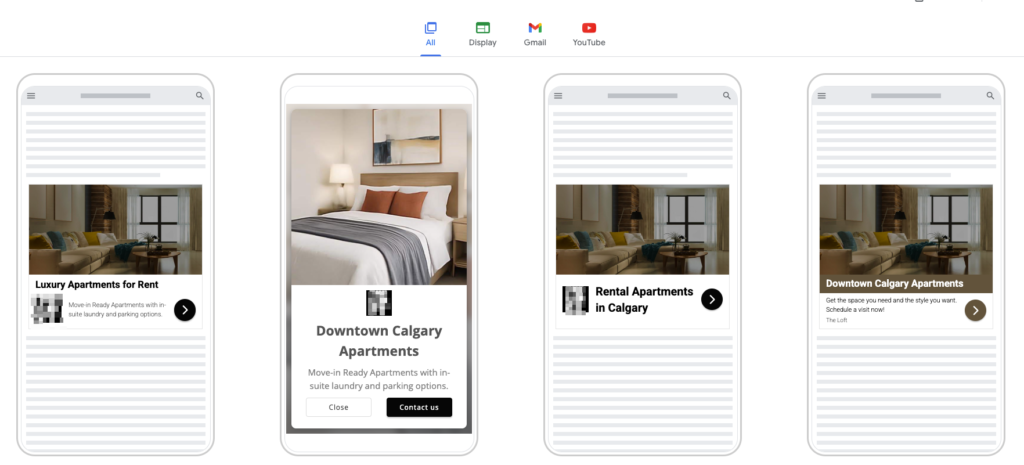
- Display prospecting
- Remarketing
- Call ads
This gave the account more control over ad relevance, search intent, bidding, and budget allocation.
2. Shift paid traffic from the homepage to floorplans
The homepage was initially used as the primary Google Ads landing page.
That created unnecessary distance between the search query and the information renters actually needed. Prospects looking for a specific apartment type were landing on a shallow overview page instead of directly accessing floorplans and unit information.
SwiftPropel gradually shifted paid traffic toward the floorplans page to create a more direct path between rental intent and available apartment options.
The floorplans section became the site’s highest-volume page during the campaign period, making it a more relevant destination for renters evaluating available units.
3. Reallocate budget as inventory changed
The campaign structure was not static.
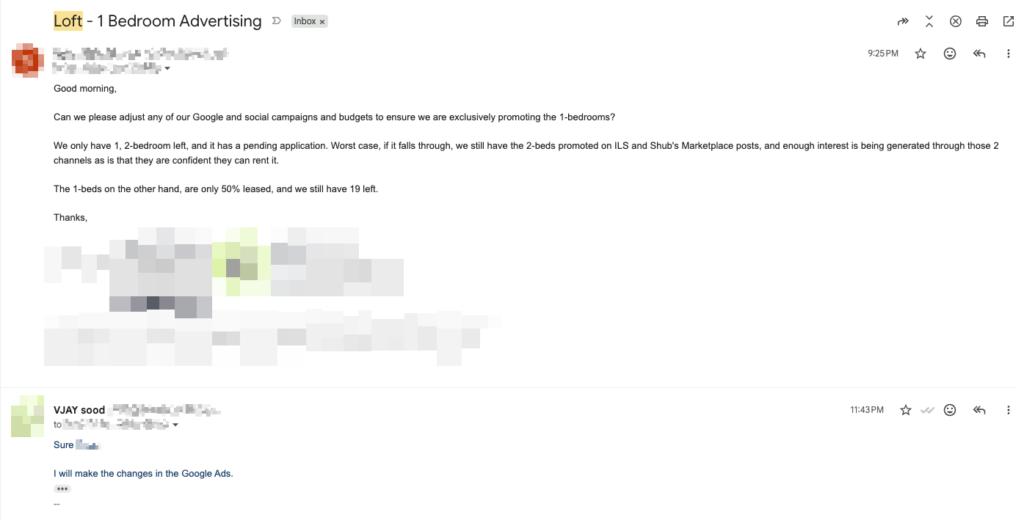
As unit availability shifted, paid-media focus was adjusted accordingly. When inventory in one unit category was close to being absorbed, SwiftPropel redirected campaign emphasis toward the unit types that still required demand generation.
This prevented paid spend from continuing to prioritize inventory that no longer needed the same level of support.
4. Improve search quality over time
Ongoing optimization included:
- Negative keyword refinement
- Keyword expansion
- Competitor targeting
- Campaign restructuring
- Search-term analysis
- Ad-copy refinement
- Bid-strategy testing
- Device-performance review
- Dayparting review
- Budget reallocation
- Remarketing audience refreshes
The goal was not simply to increase traffic. It was to make the account more relevant to renters who were actively evaluating apartment options.
5. Build a practical tracking path around the embedded form
Because the lead form was embedded through GoHighLevel, SwiftPropel worked with the client team to create a thank-you-page confirmation path for successful submissions.

This made it possible to track form-completion confirmation events in Google Ads.
SwiftPropel also recommended UTM capture and source-tracking improvements so future lead records could be more accurately attributed to the originating channel and campaign.
Results
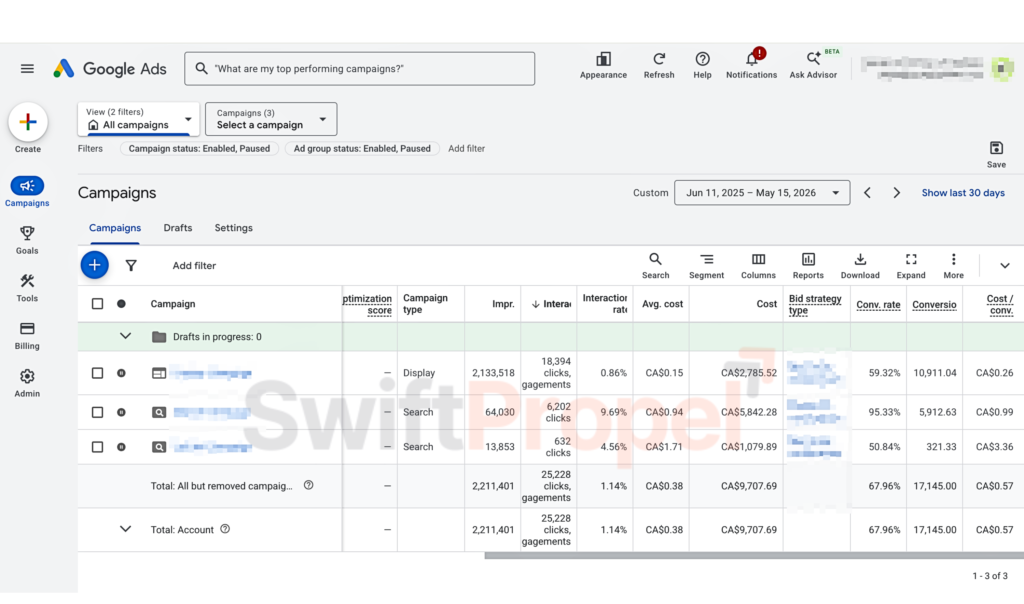
Campaign period: June 11, 2025 to May 15, 2026
| Metric | Result |
|---|---|
| Google Ads spend | CA$9.71K |
| Impressions | 2.21M |
| Clicks | 25.1K |
| Average CPC | CA$0.39 |
| Paid Search sessions | 6,763 |
| Paid Search engagement rate | 57.64% |
| Tracked form-completion confirmation events | 72 |
| Book-a-tour flow clicks | 87 |
| Contact-form jumps via “Now Leasing” CTA | 170 |
| Phone-link clicks | 40 |
What the Data Actually Shows
The account generated strong paid visibility and efficient traffic acquisition:
- 2.21 million impressions
- 25,000+ clicks
- CA$0.39 average CPC
More importantly, it created measurable renter-intent actions:
- 72 tracked thank-you-page form-completion events
- 87 clicks into the booking-form flow
- 170 direct jumps to the leasing contact form
- 40 phone-link clicks
Paid Search also delivered higher-quality on-site engagement than broader Display traffic. This reinforced the importance of prioritizing high-intent search demand, relevant landing pages, and unit-specific campaign structure rather than evaluating success purely through traffic volume.
Important Measurement Note
Google Ads reported 17,145 total conversion actions during the campaign period.
That number should not be treated as 17,145 leads.
A large share of total conversion activity consisted of softer actions such as floorplan page views, PDF downloads, registration clicks, and other engagement events.
For this reason, SwiftPropel reports the campaign using separate categories:
- Form-completion confirmation events: 72
- Booking-flow clicks: 87
- Contact-form CTA interactions: 170
- Phone-link clicks: 40
- Secondary engagement activity: reported separately and not presented as leads
Without CRM access, booked tours, qualified leads, applications, signed leases, and revenue could not be verified or attributed to individual Google Ads campaigns.
Key Lesson
For multifamily rental campaigns, a generic “apartments for rent” campaign is rarely enough.
The account needs to reflect how renters actually make decisions:
- Search by unit type
- Compare competitors
- Evaluate neighbourhoods
- Review floorplans
- Return to the site multiple times
- Call, submit an enquiry, or enter a booking flow
The performance advantage came from matching campaign structure and landing pages to those decision paths.
The goal was not to create more tracked actions.
The goal was to create a cleaner path from renter intent to a measurable leasing enquiry.
Engagement Type
White-label Google Ads strategy, buildout, campaign management, landing-page recommendations, conversion-path tracking, search-term optimization, remarketing, and ongoing media optimization.
Need a Google Ads system built around actual buyer intent rather than generic traffic?
SwiftPropel builds paid demand-generation systems that connect search behavior, landing-page relevance, conversion tracking, and budget allocation into one measurable acquisition engine.

Vijay Sood is a seasoned digital marketer with a passion for driving online growth and innovation. With a robust background in developing and executing comprehensive digital strategies, Vijay excels in leveraging SEO, content marketing, and social media to boost brand visibility and engagement. His expertise lies in transforming data-driven insights into actionable marketing campaigns, helping businesses achieve their digital objectives.