
If the consumers had clicked on the ads and purchased something right away, then it would be simple to identify whom to give credit to. For instance, the consumer had clicked our advertisement on Google and purchased something. The Google search campaign helped the transition. A customer might visit our ecommerce site because of the search ad, but additional ads will keep them intrigued until they are ready to buy. Attribution modeling aims to simplify assigning credit to various ad channels and campaigns.
Depending on the type of model you choose, attribution models figure out how much credit each touchpoint in a buyer’s journey gets for a sale. After that, you can look at your marketing efforts, determine what’s working, and then improve your plans to make them perform better. There are many models to choose from. In this article, we’ll offer you an overview of the many types of attribution models and teach you when to use each one.
What is Marketing Attribution?
Marketing attribution is the process of figuring out which marketing touchpoints (all the ways a customer interacts with a firm before buying anything) lead to a sale. It awards credit to channels such as email, social media, or paid advertising based on how much they helped a customer make a purchase decision. You can make the most of your budgets, make your campaigns function better, and grow your business faster by giving credit where it is due.
It might be challenging to comprehend and set up marketing attribution correctly, but this article makes it a lot easier. You’ll learn how to pick the best attribution model for your organization, how to highlight the value of SEO and content marketing at the top of the funnel, and how to use attribution data to help you decide how to spend your money.
What Are the Most Common Marketing Attribution Models?
Companies employ attribution models to figure out how customers behave. These models give credit to different places along the customer’s journey in various ways. Each model has its own ideas on how to give credit to each point of contact with a customer.
First-Touch Attribution
First-touch attribution says that the initial point of contact with a consumer is responsible for the conversion. This model focuses on the initial interaction that introduces the customer to the brand or product. It emphasizes the importance of this for capturing the customer’s attention and initiating the journey.
Last Touch Attribution
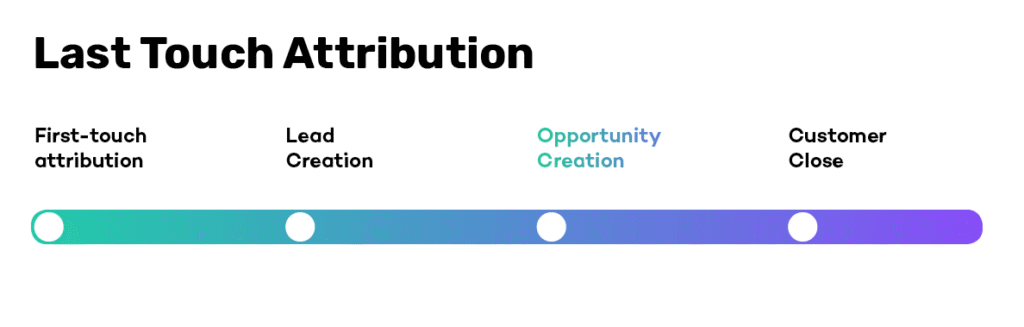
Last-touch attribution assigns all the credit for a conversion to the final touchpoint that occurred before it. It displays the last meeting that directly leads to the sale, which is critical for closing the business.
Attribution in a Straight Line
Linear attribution delivers the same amount of credit to all the points of contact along the customer’s journey. This model recognizes that every touchpoint is crucial for converting the client, so it examines how each encounter impacts the customer.
Linear Attribution
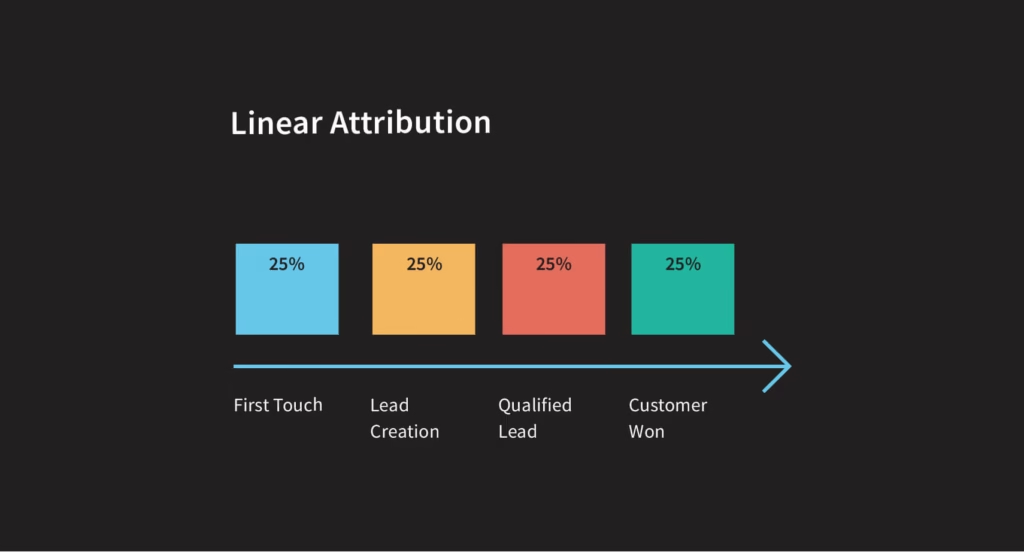
Attribution based on time gives more credit to touchpoints that happen closer to the time of purchase and less credit to touchpoints that occur earlier. It recognizes that older touchpoints have less influence and that more recent connections are more crucial in shaping the customer’s decision.
Time-Decay Attribution
Time-decay attribution gives more weight to touchpoints encountered closer to the time of purchase, gradually decreasing the credit assigned to earlier interactions. It recognizes the diminishing influence of earlier touchpoints and prioritizes recent interactions in shaping the customer’s decision.
U-Shaped (Position-Based) Attribution
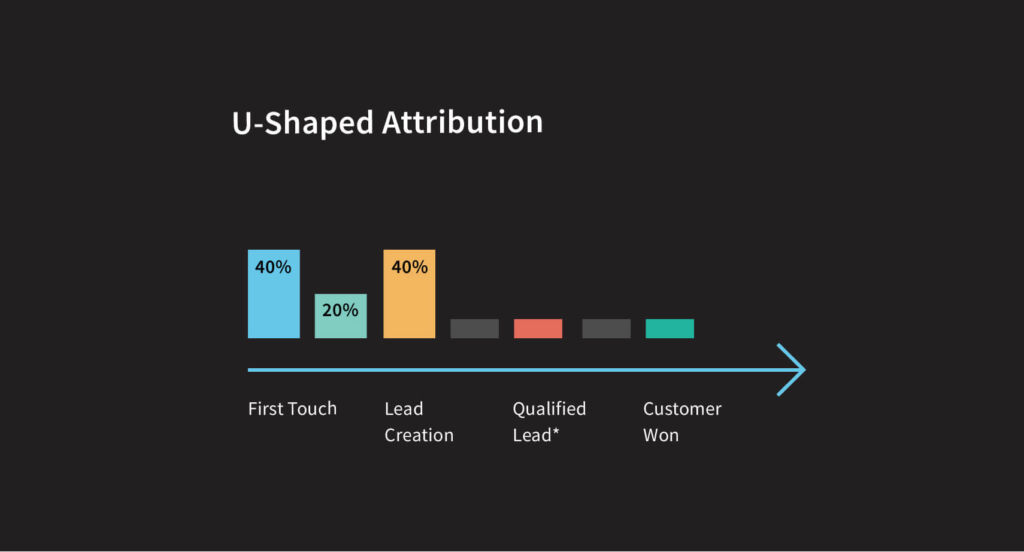
U-shaped attribution, also known as position-based attribution, offers credit to the first and last touchpoints that a consumer sees and some credit to touchpoints in between. It understands the importance of the initial engagement and the ultimate conversion as well as how touchpoints influence the process.
Pros and Cons of Various Attributions
A brand must choose depending on its business objectives and information it has; it has to choose which attribution model is best suited for it. In what follows, we will discuss more about the advantages and disadvantages of various attribution models.
First-Touch Attribution
- Pros: This strategy indicates to us the initial point of contact when the customer is exposed to view, and this can assist in determining how one can calculate brand awareness.
- Cons: This method simplifies the client journey too much, resulting in only the first interaction being seen as essential. Consequently, other places of contact could appear to be less vital.
- Examples: First-touch attribution is a perfect method of evaluating the effectiveness of introductory marketing campaigns when the main goal is to get consumers interested and aware of a product.
Last-Touch Attribution
- Pros: Last-touch attribution highlights the last touchpoint before the conversion, which helps direct response marketing activities the most.
- Cons: However, as it does not consider previous touchpoints, it may mean that those studying the client’s experience do not have full knowledge.
- Example: It is a great method when you want to link sales to certain promotional offers as it shows clearly that the last connection that leads to a purchase is what matters the most.
Linear Attribution
- Pros: Credit is equally given to all touchpoints in Linear Attribution, and thus the path of the consumer can be followed.
- Cons: The limitation of this method is that it does not depict how each interaction influences the final result, which might lead to overestimating the role of minor interactions.
- Example: Linear attribution is a good method to study the presence of the customer across different channels, as the final customer’s perception depends on all the touchpoints experienced.
Time-Decay Attribution
- Pros: This model analyzes changes that occur in the touchpoints over time, and last interactions are given the greatest weight.
- Cons: The problem here is that the impact of earlier touchpoints might be ignored, and that too much credit is given to later interactions.
- Example: Here, a customer’s behavior during a campaign is perfectly trackable, as the importance of touchpoints may possibly vary with time.
U-shaped Attribution
- Pros: U-shaped attribution looks at how essential the first and last touchpoints are in the customer’s journey.
- Cons: It might not contain enough detailed information and might miss contributions from interactions that occurred in the center of the funnel.
- Example: This model examines marketing funnels that guide customers from awareness to conversion. It provides a comprehensive overview of the entire process.
What to Look for When Picking Your Attribution Model?
There are several crucial aspects to think about when you pick the right marketing attribution model. You should make your pick based on what your firm needs, not what other people seem to be saying these days.
What do you want your business to do?
First, be clear on what you want to gain out of your marketing attribution. If you don’t, you’re just taking a shot in the dark. Are you more interested in making people want something or getting it? It won’t be as easy for you to choose between different marketing attribution models as you’d like. Each one focuses on a different aspect of the customer’s journey.

If you want to gain new customers and build brand awareness, you need an attribution model that gives the proper amount of credit to first-touch interactions and top-of-funnel activities. This is how you can get better over time.
On the other hand, if you want to obtain a quick return on your investment and enhance conversion rates, models that focus on bottom-funnel touchpoints can be better for you. Both strategies work, but they function in various ways depending on where your business is right now.
How long does it take to make a sale?
When picking an attribution model, one of the most important things to consider is how lengthy the sales cycle is. The attribution model you choose should be based on how long and complex your sales process is. In e-commerce and B2C businesses, short sales cycles are popular. These cycles typically have fewer touchpoints, and choices are made rapidly. In these situations, last-click or first-click attribution models can provide you with enough information to decide how to make things better.

For sales cycles that last a few weeks to a few months, the linear attribution model or time decay attribution model works best. These models are aware that there is more than a single interaction that propels the choice, but even so, they still place importance on the latest ones.
B2B and business-to-business sales cycles are longer in length, so you require multi-touch attribution models that can maintain interaction records at every stage of the buying process over extended time frames.
How Complex is Your Customer Journey?
Your optimal attribution model will vary based on how many touch points your consumer goes through and how complicated their path is. Single-touch models perform best for simple visits with two or three touchpoints since it is more manageable to determine which interactions are most important. It remains easy to comprehend and apply the attribution analysis. You require multi-touch attribution models to give credit where credit is due for complex trips with five or more touchpoints across multiple marketing channels.

These trips can involve multiple devices, channels, and times, so it is necessary to employ an attribution model that can handle them all. It’s just more complicated when you’re working with various devices and platforms.
If your customers are switching between mobile, desktop, and in-person engagement regularly, you’ll require attribution models and technology that are capable of bringing together discrete touchpoints for legitimate analysis.
Data Quality and Technical Skills
The attribution model you select must be aligned with the quality and form of your data. More sophisticated attribution models require better quality data and more robust technical execution. You can integrate basic tracking data with rule-based models like linear attribution or position-based attribution models. But for data-driven attribution to work correctly, it needs a lot of precise event-level data.
Also, think about how good your team is with technology. Compared to the simple rule-based methods that most marketing platforms offer, custom attribution models and machine learning methods need more advanced analytics skills and constant maintenance.
What’s the Best Attribution Model for Ecommerce?
There is no single methodology that works perfectly for marketing attribution. The best model for your business will depend on what you want to accomplish and how your sales funnel operates. You should also utilize different models depending on what you want to learn.
Use first-touch attribution to find out which ads are getting people to your site.
First-touch attribution is beneficial for online stores, as it reveals which ads are generating new customers. This method enables businesses to determine which ads attract the most new clients. Then, they can adjust their marketing plans to make those ads work better. This method is effective for getting people to know about your business and making them want it.
Use a last touch or time decay model to find out which ads are making people buy.
Last-touch and time-decay ecommerce attribution models can help online retailers track the effectiveness of their marketing efforts in attracting customers to purchase products. These models put more weight on touchpoints that are closest to making a sale. Businesses may learn a lot about which commercials inspire people to buy things and then adjust their marketing strategy to make them even better by using these models.
To get an overview of your marketing efforts, you have a few options.
Companies that want to get a better overall picture of their marketing efforts can use both U-shaped and linear ecommerce attribution. These models enable businesses to track the progress of each step in the customer journey. This helps them identify which parts of their marketing plan are working well and which ones need improvement. The U-shaped paradigm, on the other hand, thinks that the first and last touch locations are more crucial.
Data-driven ecommerce attribution models are better than other types, but they may be expensive to set up and keep running. This is because they must deal with a large amount of data, which can be complex and time-consuming. If you use Google Ads, though, you can use Google Analytics’ built-in data-driven ecommerce attribution mechanism to get accurate information about how well your campaign is doing.
Google Ads’ data-driven ecommerce attribution method uses all of the information that Google Ads can get to, including statistics on transactions, conversions, impressions, and clicks. This helps businesses understand how different touchpoints impact their sales and make informed decisions about how to effectively market themselves. If you run ads on sites other than Google, like Meta or Amazon, this outside data won’t be tracked.
There are a few factors you need to consider when choosing an ecommerce attribution model:
- The business’s goals: What do you want to get from your business’s marketing? Different ways of attributing ecommerce work well for other items.
- The customer’s trip: What does your customer’s journey look like? What parts of the travel do you want to keep track of the most?
- The total number of channels: If you don’t have a lot of marketing channels, it will be easy for you to use a simple single-touch attribution strategy. However, if your customer’s journey is more complex and involves multiple channels, you may want to employ a more comprehensive multi-touch strategy.
- Data availability: What kinds of information can you access? What is the best way to maintain track of the data you have for ecommerce attribution?
- Cost: It can be costly to set up and keep up a data-driven ecommerce attribution system. Weigh the benefits and downsides of using this kind of model before you make a decision.
What you need and want will determine the best ecommerce attribution model for your business. To select the best ecommerce attribution model for your business, you need to carefully look at your marketing efforts, keep a close check on your conversions, and try out a few different models until you find one that works well for your sales funnel.
Conclusion
You need to know how customers travel through your business, be willing to adapt it all the time, and make sure that the marketing attribution model you chose aligns with your business goals. If brands are willing to adjust and consider these elements, they may learn a great deal from their attribution efforts and continue to improve their marketing.
An effective attribution system not only helps you get the most out of your money, but it also shows you which channels are beneficial for your business. Companies that put time into making their models stronger may make better judgments based on data, which gives them an edge over their competition. The goal is to view attribution as something that evolves as customers behave and the market changes.

Vijay Sood is a seasoned digital marketer with a passion for driving online growth and innovation. With a robust background in developing and executing comprehensive digital strategies, Vijay excels in leveraging SEO, content marketing, and social media to boost brand visibility and engagement. His expertise lies in transforming data-driven insights into actionable marketing campaigns, helping businesses achieve their digital objectives.