Google Performance Max (PMax) campaigns are basically automated campaigns that can be run across Google’s entire network without the need to select specific placements. The machine learning used in these campaigns is very powerful, and it will search for and convert customers from wherever they are on Google. These campaigns are no longer limited by the restraints of the traditional campaign types in that they will employ the use of every available ad placement while focusing only on the conversion goals that you have set.
To be able to tap into the huge power that these campaigns offer and be able to maximize the Return on Investment (ROI), one has to understand very well the core creative structure of the campaign, which is the Asset Group. In this article, we will explore what Asset Groups are, how they function step-by-step within the PMax framework, and the key benefits they offer for reaching your most profitable customers.
What Are Asset Groups in Performance Max Campaigns?
Simply put, an Asset Group is a bundle of creative elements (assets) that the AI of Google automatically combines to make and deliver the most suitable advertisements everywhere where all the channels that are eligible permit.
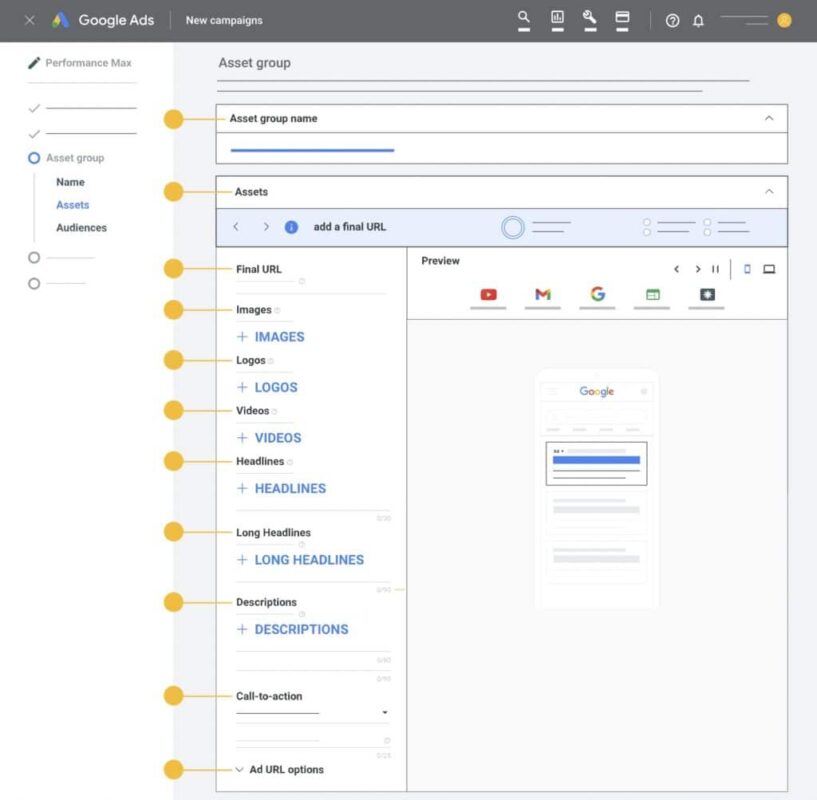
Typically, each Asset Group will have performance max asset group settings, which include the following:
- Final URLs: The landing page(s) where the users will be directed to.
- Text Assets: Five headlines (30 characters), 5 long headlines (90 characters), and 5 descriptions (90 characters) at most.
- Image Assets: 20 images at the most (including landscapes, squares, and portraits).
- Video Assets: 5 videos at most, or if the user does not provide a video, Google will create one automatically.
- Business Name & Logo: For brand standardization purposes.
- Audience Signals (Optional but Crucial): AI gets the most help from you when you give it hints about who your most probable converters are (e.g., custom segments, customer lists, interests).
Most importantly, the Asset Group employs these signals for directing the target to the priority position, as opposed to excluding them. Asset Groups aim to give the Google AI enough different pieces of work to create asset groups to come up with thousands of different ad versions and to be able to find the one that performs the best for every user.
Step-by-Step: How the Asset Group Works in Performance Max Campaigns
The best thing that happens in the PMax performance is how the Google AI reads what the components of the Asset Group are and then applies machine learning to carry out the goals of the conversion. The sequence of the work is basically as follows:
1. Asset Permutation and Ad Creation
With the help of Google AI, all the works of one Asset Group, be they the texts, the images, or the videos, are taken, and the AI is left to do its own thing. The AI will come up with a huge variety of ad versions that it will show in the format most suitable for the surface (e.g., a short headline/square image on Display, a long description/video on YouTube).
2. Targeting and Signal Prioritization
This is the place where Audience Signals come in handy. Although these PMax campaigns are there to serve the purpose of a broad reach, the AI will first of all show the ads from the Asset Group to the users that you have defined in your Audience Signals. If the AI sees that it can get more of your goal (e.g., higher conversion value) by going further than those signals, then it will do so. The asset group’s targeting is the point from which the AI starts its work, not a firm boundary.
3. Real-Time Performance Assessment
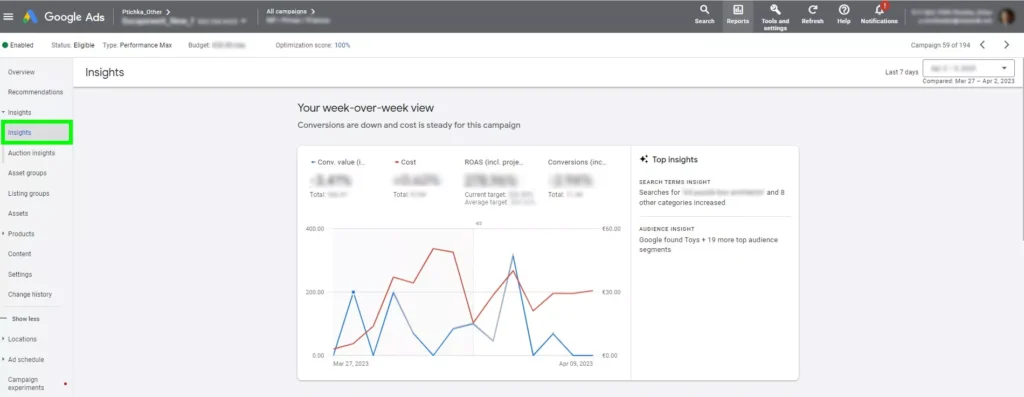
The algorithm that learns from a lot of data is, at all times, keeping track of which ad elements (e.g., Headline 3 + Description 2 + Image A) lead to the best results for different groups of people and different platforms. It measures the effectiveness of the tested combinations based on the set objective of the campaign (e.g., conversions, conversion value).
4. Bidding and Budget Optimization
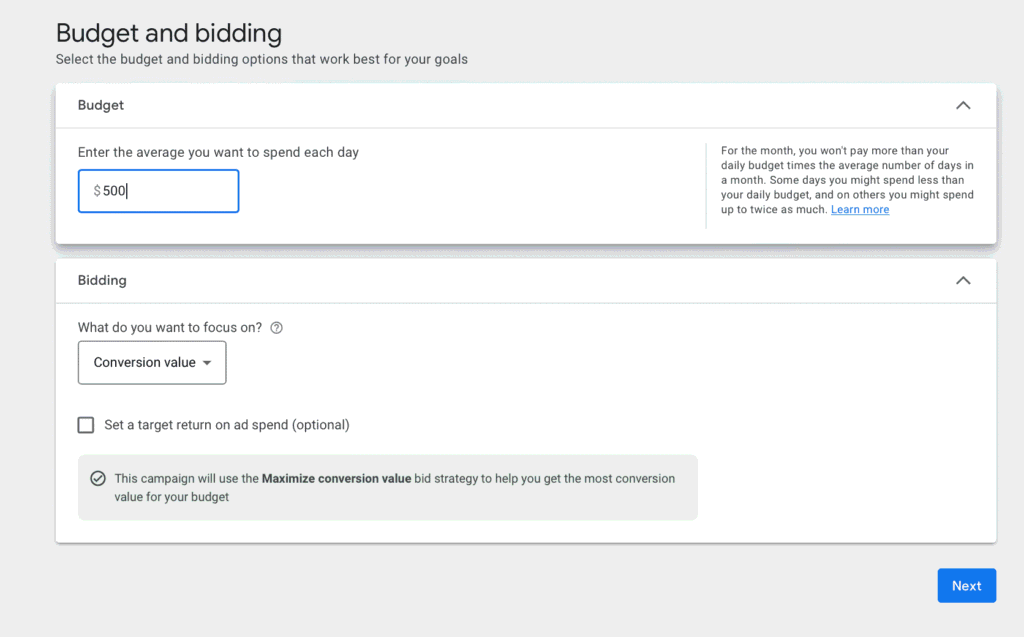
The AI leverages automated bidding (such as Target CPA or Maximize Conversion Value) to distribute the budget and increase the bid for the ad permutations, as well as the ad placements that appear to deliver a successful conversion, which are based on the real-time performance evaluation.
5. Prioritization of Asset Groups
Suppose you have several Asset Groups in one single PMax campaign (every one of them covering a different product line or target audience); the AI decides the first one whose ads will be shown, as it forecasts the conversion goal will be attained most efficiently for a particular user by that Asset Group.
Essential Benefits of Strategic Asset Group Structure
Proper utilization of Asset Groups is the basis of elevating PMax ROI:
1. Enhanced Message Relevance
When you divide your assets by theme, product category, or even by specific audience, you make certain that the ads produced by Google are very relevant. For instance, setting up a separate Asset Group for “Winter Coats” will enable you to feature specific pictures and titles (e.g., “Stay Warm”), which would not work in a “Summer Swimwear” Asset Group. Such relevance gets an increase in the Click-Through Rate (CTR) and quality score.
2. Improved Performance Insights
For each Asset Group, Google offers a “Combinations” report and an “Asset Details” report. Here, you get to know the particular headlines, descriptions, and images that are evaluated as the “Best,” “Good,” or “Low” in terms of performance. Hence, you can optimize PMax performance and elevate the return on investment chiefly by substituting the “Low” performance assets for which the process of performance enhancement is most accomplished.
3. Granular Audience Control (Signals)
Asset Groups are a very important tool with which you can offer AI the most valuable customer data you have through Audience Signals. The accuracy of the AI’s search can be guaranteed if you have a specific customer list and link it to the Asset Group that is most relevant to this list. This concentration helps the campaign reach efficiency in less time.
4. Efficient A/B Testing
With the help of Asset Groups, you can perform A/B testing on creative assets seamlessly without traditional campaigns’ manual efforts to set up separately by controlling the test conditions. By posting numerous variations of headlines or images to one group, the PMax AI is free to do its own work, i.e., it automatically tests them against each other in real time and gives preference to the top performers, which in turn allows you to quickly pinpoint the most effective messaging.
5. Seamless Cross-Channel Consistency
The PMax campaign ensures that whether the branding, messaging, and visual identity are seen by the user on a YouTube video, a Gmail inbox, or a search result page, they remain consistent because all the things for a single product line or theme are brought together in one group. This consistency supports brand recall and trust more effectively and on a larger scale than before throughout the entire Google environment.
Conclusion
A Performance Max campaign’s main focus is the Asset Group. It is the instrument that takes your creative insight and customer knowledge and turns them into thousands of dynamic, responsive ads. ROI maximization in PMax is not so much about traditional campaign management as it is about asset management strategy.
You help machine learning achieve optimal targeting, maximum relevance, and superior conversion value across all of Google’s channels by forming separate, theme-specific Asset Groups and supplying strong Audience Signals. Based on Google’s input, you then continuously replace the lowest-performing assets to keep your Performance Max campaigns efficient and effective.

Vijay Sood is a seasoned digital marketer with a passion for driving online growth and innovation. With a robust background in developing and executing comprehensive digital strategies, Vijay excels in leveraging SEO, content marketing, and social media to boost brand visibility and engagement. His expertise lies in transforming data-driven insights into actionable marketing campaigns, helping businesses achieve their digital objectives.