Would you like to improve the performance of your Google Ads? But can’t figure out how to do it effectively? The truth is, optimizing your Google Ads campaigns for driving traffic, generating leads, and increasing sales is very doable for you. However, there is more to a campaign than just its launch. Continual refinement of your work is what it takes to be successful. This brings about better click-through rates, more efficient spending, and greater user interaction.
Therefore, if you are consistently tweaking your Google Ads campaigns, you will be able to guarantee that each dollar spent will optimize your Google Ads campaigns to bring you better results and increase your ROAS. In this article, we will discuss proven methods to help you get the most out of your Google Ads. With tried and tested Google Ads optimization techniques, you will learn how to enhance your campaigns, become more relevant, and achieve your advertising objectives.
Why Google Ads Optimisation is Crucial for Your Business
With the help of a well-functioning Google Ads campaign, your brand can easily become the first thing that comes to a potential customer’s mind. However, a PPC trip without a plan is like going on a sailing trip without a compass. Planning your Google Ads campaign is a must if you want to avoid the double traps of unnecessary spending and poor performance of your ads.
By thorough Google Ads optimization, not only do we elevate ad visibility, but, at the same time, we significantly increase the user engagement and conversion rates. Most importantly, this strategy is not about getting thousands of clicks, but rather about getting the right ones that will later convert into loyal customers.
10 Expert Tips to Optimize Your Google Ads
Being a master of Google Ads involves more than merely launching campaigns; it is about continually enhancing every aspect for the greatest effect. Here are 10 expert-supported ideas that will help you efficiently utilize your campaign, lessen the wasted budget, and increase your ROI.
1. Advanced Keyword Optimization Techniques
Keywords are the main support of your Google Ads campaigns. To improve your ad targeting, increase user relevance, and finally achieve a higher ROI through up-to-date technologies in keywords. With advanced keyword optimization, you will be able to better serve your target audience, increase the relevancy of your ads, and finally accomplish a greater return on investment (ROI). These are some of the techniques to elevate your keyword usage strategy:
Negative Keyword Management

Negative keywords are a must-have in an optimally targeted Google Ads campaign. By using account negative keywords, the ads are not displayed if the prospects enter irrelevant query terms. By doing so, advertisers cut down on unnecessary costs and increase the whole campaign’s performance. Make a habit of updating and checking your negative keyword list regularly so that your campaigns are optimized.
Long-Tail Keywords

The long-tail keywords are very detailed and have lower competition in search engine results, but normally have less search volume and, by the same token, higher conversion rates because they are more in line with user intent. You can reach highly targeted and thus more convertible traffic through the use of long-tail keywords, which in turn will result in a lower cost per click and higher conversion rate.
Keyword Performance Analysis
It is very important to regularly review your keyword performance as part of the process for Google Ads campaign optimization. Find out which keywords are performing well and which ones are not, accordingly adjust your bids, and think of stopping or replacing low-performing keywords with the more relevant ones. This constant endeavor will deepen your understanding of the keyword strategy and thus will enhance the optimization of return on investment.
2. Precise Targeting and Bidding Strategies
It is the essence of digital marketing to be able to present the right offer to the right person at the right moment. With the help of advanced targeting and bidding strategies, you can make this a reality. The following are some of the techniques that can help you achieve a high level of performance in your Google Ads campaign:
Demographic and Affinity Targeting

Implementing demographic and affinity targeting methods will enable you to address users on the basis of features like age, gender, location, and trends. With such microscopic detail, you can see your ads perform better. customize your ads to fit your audience, thus increasing the ad relevance and the following higher engagement and conversion rates.
In-Market Audiences
In-Market Audiences are there to allow you to get in touch with potential buyers who are actively seeking products or services of a kind that you offer. By appropriately using In-Market Audiences, you can deliver highly relevant ads to the users who are on the edge of making a purchase, and hence, they are the ones most likely to convert at your website.
Bid Adjustment Strategies

Implementing different bid adjustment strategies will play a major role in your ad performance and ad spend optimization. You should think of modifying bids according to the factors, such as device type, geographical area, and time of day, that would shorten the commercial period and lead to more conversions at your site.
3. Optimize Landing Pages for Ad Relevance
A landing page should be able to convert visitors and keep your quality score high by offering a seamless user experience. In other words, the user journey should be clear and timely from Google Ads through the landing page. When the content of the landing page is in line with the message of the ads, users tend to be more engaged and are more likely to take action. This correspondence not only improves user experience but also gives a signal to Google about the relevance of the ad, which in turn leads to higher ad rankings and lower CPC.
- Make sure to optimize your Google Ads account regularly.
- CTAs like “Get Started Today” or “Download Your Guide” are good examples of clear and actionable CTAs that go hand in hand with the user goal.
- As mobile devices are responsible for 53% of PPC clicks, it is necessary to be mobile-friendly.

By conducting competitive PPC analysis, you can pinpoint the areas where your competitors are strong and make sure that your Google Ads and landing pages get more attention than others in a crowded market.
The fundamental areas for optimization are:
- Pages that open faster have significantly lower bounce rates, and conversions may decrease by 20% if there is a 1-second delay in load time. You can solve performance issues with tools like Google PageSpeed Insights.
- Simplify the design, remove the noise, and make sure your message is concise. Let the main feature of your product/service be highly visible above the fold.
Creating a landing page that supports your ad and puts user experience first will lead to higher engagement and will be Consider how to make your ads a source of additional income for your Google Ads account.
4. Test Different Ad Formats

Google Ads allows you to use different formats in your campaign to show ads that capture attention, which are essential for success. Each format has its own set of benefits; by trying them, you will be able to determine which format suits you best.
- Search ads: These advertisements are directed towards people who are actively searching for particular products or services, thus making them very effective in generating the right kind of clicks and conversions.
- Display ads: These kinds of Google Ads are made to attract the attention of the audience through visually attractive information and are, therefore, the best choice for the promotion of a brand and the extension of its reach throughout the large network of Google.
- Video ads: One of the ways these ads do this is by storytelling; thus, these ads establish an emotional connection with the viewers, which in turn increases the brand’s exposure and leaves a lasting impression.
- Shopping ads: These ads, equipped with product images, prices, and direct purchase links, make the buying process more comfortable and thus increase the sales volume of eCommerce businesses.
By trying out different formats, you will also be able to find out how different audiences will react to different materials. For instance, younger people may respond better to video commercials, whereas B2B buyers may prefer search ads for getting specialized solutions in their Google Ads account.
By mixing formats within a campaign, such as search advertisements and display retargeting, you can create a synergistic effect, which in turn will lead to higher engagement of customers at various stages of their journey. Using a data-driven strategy to plan campaigns is a sure way of ensuring that the campaigns will reach the right audience, be financially efficient, and make a measurable ROI.
5. Ad Creative and Ad Scheduling Optimization
Optimization of your ad creative and scheduling is the key to arriving at better engagement levels and higher conversion rates. Below are some of the techniques that can help you improve your ad performance:
Ad Creative Testing
Repeatedly experiment with different ad creative components; for instance, Use best practices for headlines, descriptions, and calls-to-action to improve your ad group performance. figure out which mixture is most appealing to your target market. Through the application of ad creative testing, you will be able to discover which ads are most successful in engaging users and thus leading to conversions.
Assets
Utilize assets (the former name of the ad extensions) to give more details to the user, such as providing phone numbers, addresses, or additional links to your website, thus making your ad more effective and attracting more user engagement. Google Ads provides a variety of extensions, for example, sitelinks, callouts, and structured snippets, which can be employed to offer more benefits to users and to increase your ad’s visibility in the search results.
Ad Scheduling Optimization

Optimize your ad scheduling by looking at the performance data of your campaign, such as impressions, clicks, and conversions over time. Knowing the time when your ads deliver the best results can give you a chance to plan your ad budget more efficiently and achieve better results.
6. Crafting compelling headlines and descriptions
Your ad headlines should be eye-catching by being simple, addressing the needs of the customer, and matching the content of the user query. Make use of relevant keywords in a natural way in your headlines so as to increase the relevancy of your ads and the quality Score. In the case that you were promoting running shoes, the headline “Shop Quality Running Shoes Online” would be the one that speaks most directly to the situation of the potential buyers.
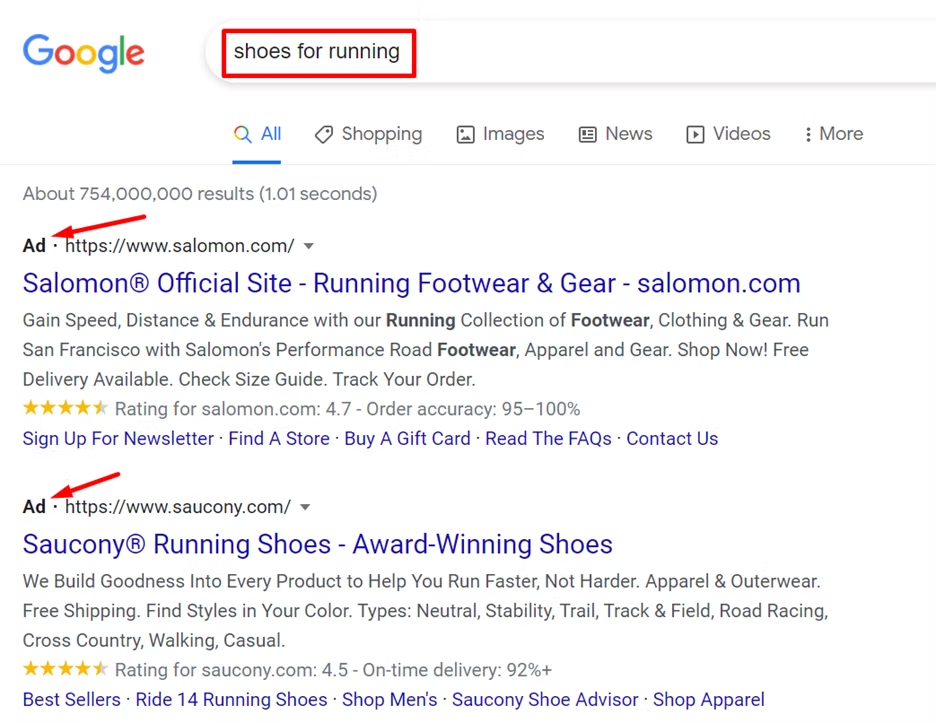
Descriptions are the parts of the advertisement that deliver the message that the product or service is really useful after fleshing out the headline with additional facts and benefits (USPs). What you could be doing for your product advertising is to let your customers know that the product/services you are marketing will be shipped for free, or there may be certain offers or discounts, which are all limited in time. Such a scheme can convince readers that your ads are worth their attention more than the competitors.
7. Selecting Effective Calls-to-Action (CTAs)

An effective CTA leads visitors to perform the intended action. Employ words of a specific action type that are compatible with the objectives of your campaign. Transfer messages such as “Shop Now,” “Get a Free Quote,” or “Sign Up Today” are examples of how the following step is made evident to the user. Steer clear of using generic CTAs, as they might result in lower levels of engagement and hinder your return on ad spend.
8. Use Ad Extensions for Enhanced Visibility
You have the possibility of adding extensions to your ads via the Google Ads dashboard. Extensions are extra parts of an ad that may talk about your shop location, the goods, the contact info, or the running promotions, while giving the readers more info to learn about your business by analyzing your ad platforms.

By employing these extensions tactfully, you can up your conversion volume by handing over to visitors the info that entices them to convert without having to go to the landing page. Suppose there is a person searching for gardening equipment rentals who is in a hurry to rent. In that case, putting performance max strategies in your campaign can lead to better results. Make sure to include your phone extension in your PPC campaign to allow them to call you right away.
9. Experiment With Ad Variations Using A/B Testing
One of the most effective ways to get better Google Ads results is A/B testing. Through these tests, you can produce different versions of any ad feature to see which one brings more interaction, and eventually, the revenue goes up.

Decide on the parts you want to compare. These may be your headlines, descriptions, and CTAs, which can be refined for increased sales. Pay attention to how the straightforward headline “Buy Now for 20% Off” is different from the ad copy that leaves you wanting to learn more, such as a compelling headline. Variations are shown to different groups, and the result of the performance metrics indicates which get higher CTRs and conversions.
Essential elements to test are:
- Headlines: Experiment with different types of text, intentions, or volume to determine what is most acceptable to your readers and results in a higher number of them clicking your ads.
- Descriptions: Test a short, engaging, benefits-driven copy against a long, detailed, explanatory version. Typically, benefit-driven statements are the ones that lead to more sales.
- CTAs: By substituting “Learn More” with “Shop Now” and trying out different action words, you can find the word that leads to a better level of engagement and subsequently performs the primary function of a CTA, encouraging users to act.
The Google Ads reporting interface is designed to keep track of metrics such as CTR, conversion rates, and cost per conversion that can be used to determine which versions are the best. A/B testing tactics ensure the relevance of your ads, which in turn leads to an improved overall strategy and ROI.
10. Set Up Conversion Tracking to Measure Success

Conversion tracking is the main thing you have to do if you want to know Determine whether your campaign aligns with the search terms that drive traffic. works out or not. It is the source of effective money spent on the right things, Google Ads tactics optimization, and ROI assessment. In the absence of it, actions are taken based on mere assumptions, which may result in a loss of money and a worse performance of the campaign. Here are some actions that you can take:
- Clarify Main Actions:Identify user interactions that bring the most value and are in line with marketing goals, e.g., downloads, signups, or purchases.
- Initiate Google Ads Tracking: Place tracking codes on corresponding sites or events, e.g., event snippets or the global site tag.
- Review your setup: Make sure the tracker is properly set up to capture all the user actions and conversions you intend to track.
- Scrutinize your ad performance: Look at the conversion figures regularly to figure out which ads, keywords, or audiences are yielding the best results.
- Put insights into action for campaign success:Apply the data to target more accurately, adjust bids, and use the money where it will bring the best results.
If these steps are performed thoroughly, Google Ads campaigns can be turned into engines powered by data, capable of producing measurable success as well as continuous growth.
Conclusion
In order to improve the user experience and ensure that the quality of ads is maintained, Google updates its advertising rules quite often. As an example, Google has made an announcement that first-click, linear, time-decay, and position-based attribution models are going to be removed, and only data-driven attribution will be available for all conversions.
Keeping abreast of the changes is a must if you want to be on the safe side and also be able to make use of newly released features or adjustments that may have an impact on your campaign performance. The incorporation of these cutting-edge strategies, along with being in the know about policy updates, will help you take your Google Ads campaigns to another level and achieve higher results.

Vijay Sood is a seasoned digital marketer with a passion for driving online growth and innovation. With a robust background in developing and executing comprehensive digital strategies, Vijay excels in leveraging SEO, content marketing, and social media to boost brand visibility and engagement. His expertise lies in transforming data-driven insights into actionable marketing campaigns, helping businesses achieve their digital objectives.