Do your Google Ads have the claimed amount of impressions? Or are they bypassing a multitude of possible ad placements that could boost valuable clicks and conversions, ultimately affecting their PPC strategy? When it comes to ads, any business wants to maximize its ROI; therefore, tracking its performance in terms of visibility is for sure key. Without tracking impression share, an advertiser might be operating in the dark—oblivious to the opportunities slipping through their fingers. Tracking this metric allows advertisers to discover some overlooked gaps in their campaigns and plan to gain the upper hand over their competitors.
Google does provide impression share as a metric for advertisers, which enables them to display the percentage of impressions captured. This also allows advertisers to identify areas in need of attention in their campaigns and take the necessary action to achieve improved results. In this article, we will discuss ways to improve impression share in Google Ads. So, let’s get started!
What is impression share?
Impression share is one of the metrics that are calculated from the Google Ads account, and it shows how many impressions your ads have gotten versus the number of impressions they could have gotten. As with most other metrics, it is shown in percentage form. Here is how it works for ads on the search network and the display network:
Actual Impressions / Eligible Impressions x 100% = Impression Share
Suppose that your ads garnered 500 impressions, and in reality, you could have gotten 1000 impressions. In this case, your impression share is equal to 50%. (500 / 1000 x 100% = 50%).
Google Ads also provides this metric for Shopping campaigns, but the formula works differently. Shopping campaigns are allowed to show multiple ads from the same advertiser, but the impression share formula only looks at the topmost-ranked ad for the calculation. No matter what campaign type you use, how Google Ads counts eligible impressions directly affects your CPC. The system looks at the ad rank, targeting, and status of approval, among others.
5 Strategies to Improve Google Ads Impression Share
Are you looking for an increase in the metric? Below are strategies that are designed to improve this metric.
1. Change the Campaign Budgets
Budget limits impact impression share. Greater spending on Google Ads leads to greater impression share. This will increase your impression share. Check your campaign status for a low daily budget. If it is showing “Limited,” then chances are increasing the daily budget will increase impressions.

Try looking for suggestions on Google Ads to get more impressions and improve your overall campaign performance. If there is a suggestion to increase the budget to capitalize on greater traffic, then surely your budget can be adjusted in that case. What your impression share tells you is a perfect metric for budgeting and can help you decide whether to increase your budget.
If an advertiser is capturing a small percentage of impression share, like 20%, they should be making significant increases in the budget. Reallocation of budgets to better-performing campaigns is likely to capture spare budgets, which then drive up performance across Google Ads accounts.
2. Lowering Regional Targets
Reducing your regional targets may increase your impression share. By narrowing the geographic area, your participation in competitive advertising improves in a small area, which can increase your impression share in that area. This strategy, however, has drawbacks, particularly if it leads to a low ad rank. Decreasing regional targets limits the advertising scope, which directly reduces the overall number of impressions for the campaign.

While the impression share percentage may look good, the actual volume of impressions will most likely decrease along with clicks and conversions. It is critical to determine which regions really matter for the business. Rather than spreading thin over irrelevant locations, concentrate higher spending in the better-performing areas. Striking a balance between regional targets and campaign goals is essential for maximizing impression share and campaign efficiency.
3. Reduce Impression Share with Campaign Competition
Look to ensure that every checklist item to fill is checked off to improve your impression share. Making sure that no keywords are ignored, as well as ensuring that keywords are not repeated, helps improve ad performance within the group. An overspending problem stemming from the use of a particular keyword could lead to an extremely low impression share, as well as only a few clicks. To improve upon the impression share, you may need to reduce your keyword list or consider increasing your budget.
For example, pause:
- KPIs that are associated with a low impression share and below-average click and conversion metrics.
- KPIs that are associated with a low impression share and a low ad rank can severely impact campaign success.
For these broad match keywords, make sure you check your keyword lists for exact match impression share by using this competitive metric in the Google Search keywords dashboard.
This metric measures the frequency with which a campaign attained impressions based on search queries that exactly matched the broad match search keywords against the number of times the campaign was eligible for these exact match impressions. When exact match impression share is high while search impression share is low, that indicates that the keyword match types used were not optimally selected.
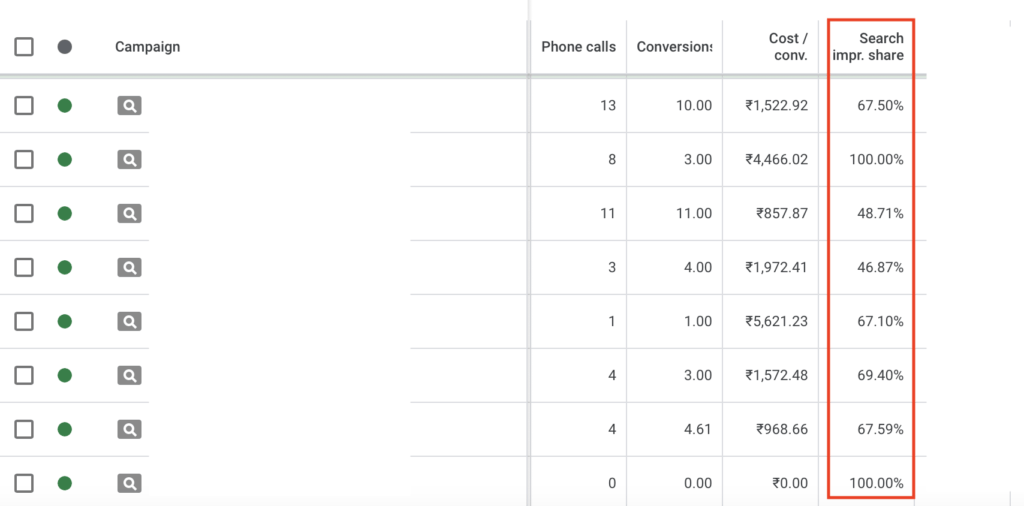
Changing broad match keywords to phrase or exact match keywords often increases the exact match impression share without excessively spending ad budget on broad matches. Check the search term report to identify top-performing keywords that can be added to your ad group.
4. Enhancing Brand Recognition
For Search Network campaigns, enhancing your ad quality can significantly increase impression share and lead to lower CPC. Better ads tend to be higher ranked because people find them more interesting and engaging, allowing for more user interaction and subsequently improved ranking and visibility. Ensure that the copy matches user intent, contains relevant keywords, and includes a clear call to action.
Also, take landing page experience into consideration. A landing page that improves quality score is one that is fast, mobile-friendly, and aligned with the ad content. A better Quality Score would mean a higher chance that ads would appear in better positions, thereby increasing impression share and click rates.
Remember to implement changes by testing various headlines, descriptions, and extensions regularly, as this helps to understand and resonate with the target audience for optimization purposes. Improving ad quality helps to gain more impressions and also more qualified clicks that drive campaign performance.
5. Revisit ad Placements
Within display ads, the available placements can provide focus with respect to the total available impressions for your ads. This setting works only when manual placement targeting is enabled, which can help improve your impression share.
Showing greater placements allows users to expand the opportunity for impressions. These opportunities also require handling impression share to maximize your ads performance. To maintain impression share, adjust the campaign budget.

Turning off low-performing placements may cap impressions to those that are more likely to generate clicks and conversions. Because you will have fewer impressions overall, your impression share should increase automatically.
Conclusion
Impression share is a critical metric for the success of Google Ads campaigns as it impacts the visibility of the campaign. However, it is not the only metric that reinforces a well-performing campaign. Balancing the impression share with other critical metrics such as click-through rate, conversion rate, and return on ad spend will yield better outcomes. Overspending the budget on a campaign focused on impression share will lead to inefficient results if other campaign objectives, such as CPC, are disregarded.
An optimized combination of impression share strategy and active campaign management will improve audience targeting, increase engagement, and drive value for the business. Lastly, in this fast-changing environment of digital advertising competition, constant monitoring and making necessary adjustments is crucial to remain relevant and competitive.

Vijay Sood is a seasoned digital marketer with a passion for driving online growth and innovation. With a robust background in developing and executing comprehensive digital strategies, Vijay excels in leveraging SEO, content marketing, and social media to boost brand visibility and engagement. His expertise lies in transforming data-driven insights into actionable marketing campaigns, helping businesses achieve their digital objectives.