Are you maximizing your Google Ads campaigns? In the constantly changing digital marketing world, being ahead of the game means being up to date on the latest technology and techniques that yield the highest return on investment (ROI) for effective ad campaigns. For companies using Google Ads, one crucial change has been the launch of Responsive Search Ads (RSAs), which are now essential for effective ad campaigns. These flexible types of ads have set the benchmark for high-performing ads, and with greater flexibility and optimization options. Keep on reading to learn how RSAs can revolutionize your paid search strategy.
What Are Responsive Search Ads?
Responsive Search Ads mark a significant upgrade over the older Expanded Text Ads, allowing for multiple headlines and descriptions. With the traditional format, you lock in a set headline and description, but RSAs flip that script by allowing for dynamic keyword insertion. You can submit as many as 15 different headlines, each capped at 30 characters, along with 4 descriptions that can each have up to 90 characters to maximize your ad’s reach.
This indicates that for each search query, the system automatically generates a new responsive search ad most relevant to the user’s search and typically displays three headlines and two descriptions. The responsiveness of your ad makes it as good an advertisement as it can be, driving the probability of engagement and creating improved ad performance.
Best Features of Responsive Search Ads for Better ROI
In order to maximize the strength of RSAs to provide enhanced ROI, it is essential to recognize their most important features and the manner in which they lead to enhanced campaign performance.
1. Dynamic Ad Generation and Optimization using Machine Learning
One of the strongest aspects of RSAs is that they have the capability to automatically generate a new advertisement from your specified assets. You input 15 various headlines and 4 descriptions, and Google machine learning handles the rest. It continually experiments with multiple combinations to find out what particular ad combinations work best for a specific search query, user context, and device, optimizing your landing page effectiveness.

This avoids advertisers having to manually craft and A/B test multiple ad variations. It learns and adapts so that the top-performing ad is displayed at any given time, ultimately resulting in a greater CTR and better conversion rate through dynamic keyword insertion. This ongoing optimization against real ad performance is an ROI maximization revolution.
2. Broader Reach and Sharper Relevance
By allowing you to load a stack of multiple headlines and descriptions, Google Responsive Search Ads deliver a tailored message to every search. Say you’ve packed your ad group with a mix of keywords; Google picks the best-fit different headline and description for the exact query a user types. This level of precision enhances the user experience and enables your ads to participate in more auctions, resulting in broader coverage of search terms and better performance of responsive search ads.

The packaging of headlines and descriptions also means your ads can adapt on the fly for different display URL variations and adjust character limits on any device, broadening your reach and nudging up engagement across your paid search campaigns.
3. Ad Strength Indicator for Optimization Guidance
Google Ads assigns an Ad Strength rating to every responsive search ad, placing it on a scale from “Poor” to “Excellent.” This rating helps you gauge the range and quality of your ad components. It also informs you whether to create new responsive search ads or look at optimizing the ones you already have, with suggestions like including extra headlines, rewording a headline to make it more unique, or including top-performing keywords.
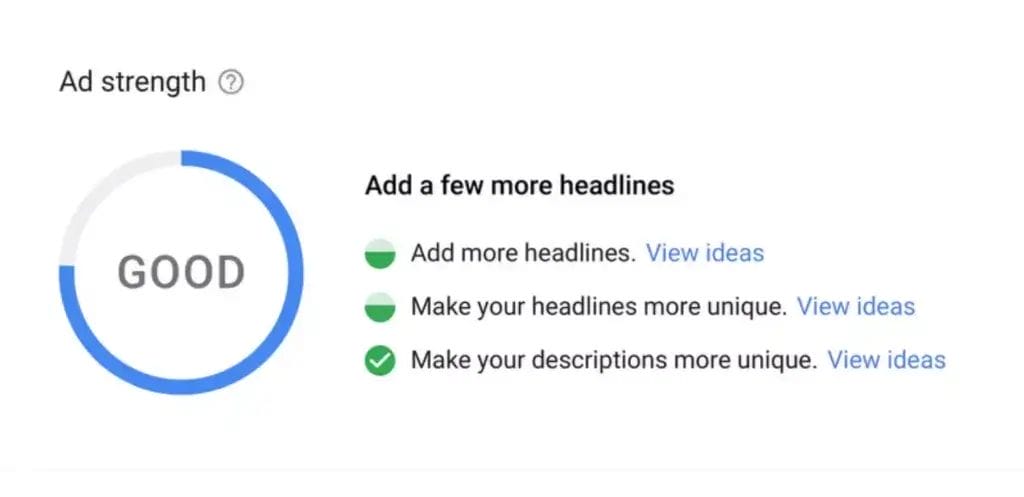
Make it a habit to review and apply Ad Strength suggestions so your ads need less tweaking and still perform well. A strong Ad Strength rating in your Google Ads account generally signifies improved unit ad performance and is a component of the success of the entire campaign, particularly in responsive search ads.
4. Pinning Options for Message Control
One of the best things about RSAs is that they adjust and modify on their own, but advertisers do have some level of control with the pinning option to create a new ad based on specific requirements. In doing this, you can pin a given headline or description to a given position, e.g., pin a headline to Position 1 or a description to Position 2. While it limits the number of singular combinations that the algorithm can try, it does serve a legitimate function when brand messaging is not in conflict with the effective ad strategy. For instance, a required disclaimer, legal note, or crucial value proposition can be pinned to ensure it always appears in the live ad, enhancing the overall effectiveness of the landing page.
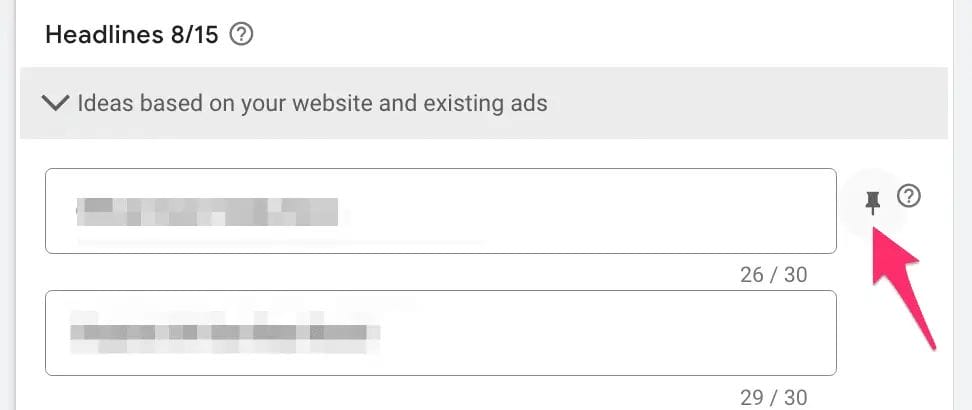
This choice is a careful trade-off between letting the algorithm refine the creative and preserving message integrity. For standard campaigns, however, the better practice is usually to let Google explore the combinations without restraint. Keep in mind that excessive pinning in your Google Ads account can backfire. If you fix too many elements in your responsive search ads, the algorithm might skip effective ad combinations that would otherwise be effective, like a description that ranks low and therefore doesn’t appear every time.
5. Detailed Reporting and Insights
Google Ads provides you with in-depth insights for responsive search ads, enabling you to track the performance of every headline and description, ensuring you can create a new strategy when necessary. The reporting zooms past surface-level stats and dives into which headline pairs with which description for every impression. That data informs you precisely what your audience resonates with, not just revealing the best-performing combinations but even the specific assets, whether a grabby headline or description, driving the most impressions and clicks.
That level of specificity is pure gold when it comes to optimizing your ad copy, illuminating calls to action that resonate, and outlining your subsequent campaigns, all of which serve to keep your return on investment trending upwards. And don’t forget to incorporate the learning from ad extensions so your results continue to improve, particularly in the context of responsive search ads.
Conclusion
Google Responsive Search Ads are not a novelty in Google Ads anymore but the linchpin of every campaign that wishes to survive, especially when using different combinations that perform best. You can combine as many as 15 headlines and 4 descriptions, and with Google’s ever-improving machine learning at your fingertips, you can set up essentially an infinite number of ads talking directly to user intent. Combine this flexibility with best practices, and you’ll see stronger engagement and a healthier ROI.
Moving from standard text ads to responsive search ads reflects Google’s push for more innovative, more relevant advertising. By providing the system with multiple creative assets and allowing it to find different combinations, you’re putting your ads in the best position to resonate with each search query. This method not only enhances performance; it also secures your campaign’s place at the forefront of paid search success.

Vijay Sood is a seasoned digital marketer with a passion for driving online growth and innovation. With a robust background in developing and executing comprehensive digital strategies, Vijay excels in leveraging SEO, content marketing, and social media to boost brand visibility and engagement. His expertise lies in transforming data-driven insights into actionable marketing campaigns, helping businesses achieve their digital objectives.